Epoche Talk 2, Procedurally Generated and Narrative
First read,
and
Game Focalization and Narrative
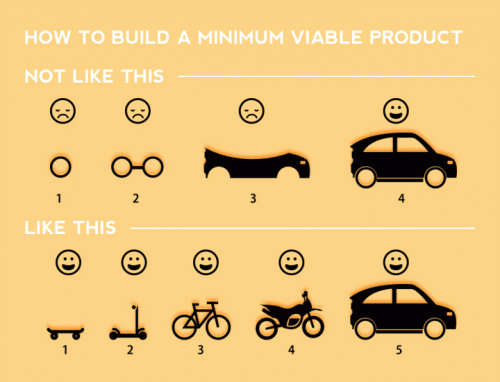
First I'm going to give a quick update of my progress. The pixel art program I'll be using for this project is freeware, which can be found here http://www.virtualuna.de/wiki.php?lang=eng&page=PixelStudioC. I'm reading into verbcoin now because I need to have a full grasp of how to code my algorithm. With this art program I'm going to sketch up some placeholder art and start the framework of the game. Which means the simplest version of the algorithm. Breaking a many scenario system down to the simplest wheels in a way that it will be instantly playable, but code in a way where the next iterations will fall into place easily (or as easily as possible), is proving to more difficult than said. Particularly with the dialogue section.
.gif)
BREAKING IT DOWN
So, what do we always do when we hit a rut? We go around, but we keep digging. Everything in a generated game is connected, but it all stems from a simple set of mechanics. So those mechanics are what I will be working on. The gameplay in each match will be broken down into five stages.
1st, the characters, the game will have to randomly generate characters fleshed out with distinguishing features, stats, and personalized inventories. Setting up a test room and test figures will be my first, and most important, challenge. The quality of the game's mysteries (as currently designed) are dependent on this stage of generation working.
2nd The basic AI movement of characters through the train cars will be directly linked to their stats. I don't have the luxury of making their movements a scripted pattern as the murders both need to have clue states and as must occur out of opportunity. When hungry the characters will go to the bar cart for a sandwich, which will be added to their inventory, which could leave crumbs on their hands, or the hands of a thief going through their pockets. The stats are a basic excuse for variables within the timeframe of each match, this effectively diversifying the instances of each match. Also by making npc's movements less predictable in later builds the player becomes more reliable on the testimony of the passengers(passive targeting and dialogue farther down). This adds suspense and strategy as the player must diplomat with --potentially-- the killer and put themselves in greater risk.
3rd, the first murder state. The combination of the stat effected movement simulation and targeting's system this is the second make or break point. Making the characters' passive/active targeting will be very very difficult.. for me. As the title implies the targeting code is how the murder selects their victim, this section will work off an expanded build of the first mechanics, expanding the stat and other variables so the game simulates the nature of the murder and the state of the crime scene. This section will eventually decide things like opportunity, weapons available, if there was a struggle, the number of clues left behind, and most importantly the imprint those instances left on the other characters. Which brings us to...
4h, claim dialogue, or better named, claim and counter claim instances. Here is where things get tricky and where my abilities with verbcoin make or break the game, each of the characters will have to have a storage system, exposure to fact states(clues) will allot them with a build of claims. Which with their passive/active targeting will organize how the AI responds to player input. This is the real meat and potatoes of the game. As the player picks up clues dialogue options are opened and they are able to 'build a case' against the npcs to decide which one they think is the murder. But dependent on the clues the npcs will be exposed to a different set of possible 'cases' and possibly against different characters, even yourself. I'm going to have to figure it so that the AI knows to respond, shifting blame(active targeting) to the claim that npc has unlocked and discrediting the claims of those it hasn't come to trust (passive targeting). This is going to be all very complicated, and in this early stage very imbalanced, broken. Which is why I'm going to need more effecting how the npc's make their decisions, how they notice features and build their clue/claim database.
5th, narrative dialogue or essentially randomized characterization/narration, is what I'm calling the extra dialogue I'll need to create. Where claim dialogue is tied to the active targeting, leading to the claims and win or fail states: the narrative dialogue is tied to the passive targeting and will result in the majority of the game's characterization. The passive targeting is essentially how a npc feels about another npc or the player, like a relationship meter, the modification here is that it is modified by the rest of the passengers. What happens is that because of the social situation the npc will assign each character a value from least to greatest (liked) and, dependent on the frequency of positive to negative responses from each character to the npc, assign biases towards those characters. This both effects how the npc will respond to the player's requests but if the npc will 'believe' the player. Certain npcs with a higher rating of the player will need less proof to be convinced of the player's claim dialogue, if that claim dialogue is proven wrong that rated will go down though. The importance of the narrative dialogue is... well the narrative. This passive targeting as an underlying feature that effects the active targeting simulates most of the mystery elements in the game. Not only through what amounts to diplomacy and cunning wit in questioning and organizing the group, but on the side of the murder it'll simulate motive and manipulation. The murders active and passive targeting act the same but as to manipulate the groups understanding of the crimes away from himself, and when the opportunity arises it simulates a murder of opportunity. This, of course, is in much later builds. And currently beyond me, but if the character creations work, and the AI movements work then half the work is done.
Tha'rrs the game plan. The five stages as currently designed, each building on previous iterations, slowly building to the more complete project. I don't have a timeline for the entire thing, I have no way of knowing how quickly I'll learn and be able to implement the code into each build, much less work out the bugs, with all of school and work. But it's definitely possible so I'm going to do it
Next time more news on code and art, maybe even some screenshots. Till then, have a good day everyone, and good luck on your projects.
First I'm going to give a quick update of my progress. The pixel art program I'll be using for this project is freeware, which can be found here http://www.virtualuna.de/wiki.php?lang=eng&page=PixelStudioC. I'm reading into verbcoin now because I need to have a full grasp of how to code my algorithm. With this art program I'm going to sketch up some placeholder art and start the framework of the game. Which means the simplest version of the algorithm. Breaking a many scenario system down to the simplest wheels in a way that it will be instantly playable, but code in a way where the next iterations will fall into place easily (or as easily as possible), is proving to more difficult than said. Particularly with the dialogue section.
(image and a good read found here)
So, what do we always do when we hit a rut? We go around, but we keep digging. Everything in a generated game is connected, but it all stems from a simple set of mechanics. So those mechanics are what I will be working on. The gameplay in each match will be broken down into five stages.
1st, the characters, the game will have to randomly generate characters fleshed out with distinguishing features, stats, and personalized inventories. Setting up a test room and test figures will be my first, and most important, challenge. The quality of the game's mysteries (as currently designed) are dependent on this stage of generation working.
2nd The basic AI movement of characters through the train cars will be directly linked to their stats. I don't have the luxury of making their movements a scripted pattern as the murders both need to have clue states and as must occur out of opportunity. When hungry the characters will go to the bar cart for a sandwich, which will be added to their inventory, which could leave crumbs on their hands, or the hands of a thief going through their pockets. The stats are a basic excuse for variables within the timeframe of each match, this effectively diversifying the instances of each match. Also by making npc's movements less predictable in later builds the player becomes more reliable on the testimony of the passengers(passive targeting and dialogue farther down). This adds suspense and strategy as the player must diplomat with --potentially-- the killer and put themselves in greater risk.
3rd, the first murder state. The combination of the stat effected movement simulation and targeting's system this is the second make or break point. Making the characters' passive/active targeting will be very very difficult.. for me. As the title implies the targeting code is how the murder selects their victim, this section will work off an expanded build of the first mechanics, expanding the stat and other variables so the game simulates the nature of the murder and the state of the crime scene. This section will eventually decide things like opportunity, weapons available, if there was a struggle, the number of clues left behind, and most importantly the imprint those instances left on the other characters. Which brings us to...
4h, claim dialogue, or better named, claim and counter claim instances. Here is where things get tricky and where my abilities with verbcoin make or break the game, each of the characters will have to have a storage system, exposure to fact states(clues) will allot them with a build of claims. Which with their passive/active targeting will organize how the AI responds to player input. This is the real meat and potatoes of the game. As the player picks up clues dialogue options are opened and they are able to 'build a case' against the npcs to decide which one they think is the murder. But dependent on the clues the npcs will be exposed to a different set of possible 'cases' and possibly against different characters, even yourself. I'm going to have to figure it so that the AI knows to respond, shifting blame(active targeting) to the claim that npc has unlocked and discrediting the claims of those it hasn't come to trust (passive targeting). This is going to be all very complicated, and in this early stage very imbalanced, broken. Which is why I'm going to need more effecting how the npc's make their decisions, how they notice features and build their clue/claim database.
5th, narrative dialogue or essentially randomized characterization/narration, is what I'm calling the extra dialogue I'll need to create. Where claim dialogue is tied to the active targeting, leading to the claims and win or fail states: the narrative dialogue is tied to the passive targeting and will result in the majority of the game's characterization. The passive targeting is essentially how a npc feels about another npc or the player, like a relationship meter, the modification here is that it is modified by the rest of the passengers. What happens is that because of the social situation the npc will assign each character a value from least to greatest (liked) and, dependent on the frequency of positive to negative responses from each character to the npc, assign biases towards those characters. This both effects how the npc will respond to the player's requests but if the npc will 'believe' the player. Certain npcs with a higher rating of the player will need less proof to be convinced of the player's claim dialogue, if that claim dialogue is proven wrong that rated will go down though. The importance of the narrative dialogue is... well the narrative. This passive targeting as an underlying feature that effects the active targeting simulates most of the mystery elements in the game. Not only through what amounts to diplomacy and cunning wit in questioning and organizing the group, but on the side of the murder it'll simulate motive and manipulation. The murders active and passive targeting act the same but as to manipulate the groups understanding of the crimes away from himself, and when the opportunity arises it simulates a murder of opportunity. This, of course, is in much later builds. And currently beyond me, but if the character creations work, and the AI movements work then half the work is done.
Tha'rrs the game plan. The five stages as currently designed, each building on previous iterations, slowly building to the more complete project. I don't have a timeline for the entire thing, I have no way of knowing how quickly I'll learn and be able to implement the code into each build, much less work out the bugs, with all of school and work. But it's definitely possible so I'm going to do it
Next time more news on code and art, maybe even some screenshots. Till then, have a good day everyone, and good luck on your projects.


