Showing posts with label Development. Show all posts

Sunday, January 3, 2016

ENTERING A GAME JAM

Short life Update
I'm officially only doubly employed, and in a much better position starting this year than I ended the last; and so I've joined a Game Jam. Because only being doubly employees with two academic essays to write and three custom orders resting on the work bench, I'm sure to have enough free time.
I'm using Tom Francis's "Make A Game With No Experience" youtube Game Maker series as a blueprint for my submission and between everything I'll try to keep track of my progress. 

This is just a quick post to help boost the My First Game Jam's signal and a little encouragement for anyone else looking for that extra little push to get them working.  

And because this is too short of a post I'm going to ramble some in the form of a list.
While I've never finished a project, there is some advice I can offer.

10 MISTAKES TO AVOID MAKING YOUR FIRST FAST AND DIRTY GAME

Or


10 REASONS THIS WRITER HAS FALLEN FLAT ON HIS FACE TRYING TO MAKE GAMES


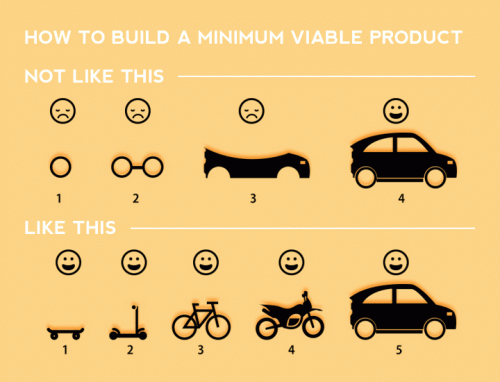
1. REMEMBER IT IS FAST AND DIRTY
People new to game making fall into this pit without even noticing, it's knowing when to cut your losses and call what you have done. It won't be perfect, that's what Game Jams are all about, so don't worry about making it looked polished. Just like when you write your paper the night it's due, first get a completed draft, then work out your most egregious errors, and keep working away at those for as much time as you have left on the clock. Fix the game breaking bugs, play it though to make sure everything's triggering how it should, and slap something like art over the top of it.

2. FUN TRUMPS SENSE
You'll find alot of indie games fall into the trap of making a game "by the blueprints". Designing and writing events into the game because that's what the creator expects to be in this or that sort of game. Firstly it leads to a dull same-ish genre piece we've seen and mostly forgotten about, and secondly it leads to you accidentally plotting out something that is out of your league. The rule of Keep It Simple Stupid, has never been more applicable and the simplest you can get without fault is a game where, regardless of how short or how badly drawn, the play is fun. This is your first game, don't concern yourself what happens after the queen is taken, or why she's taken, or who you even are for that matter until you already have boxes onscreen that are coded to damage, jump, and follow each other around; and all of those actions are fun. It's a harsh lesson, but if walking and shooting, or whatever, doesn't feel engaging and responsive to the player, if the thing the player has to do in the game doesn't feel rewarding, nothing else can save that game. Do not worry if the dragon showing up makes sense until the act of shooting it is fun in itself.

3. FUN IS SIMPLE
Where rule 2. is "don't design the game before you have the gameplay", rule 3. is "Keep Gameplay Stupid." Complex code and mechanics will do you no good when you're trying to iron out gamemaking bugs for code you've just learned. You are new to coding, you are new to game design, you have a very quickly approaching deadline; look for the simplest game type to code with the simplest tutorial series you can find. The mantra of the gamemaker; simple to learn, hard to master, is your friend. Not just because complex inputs and mechanics take more time trying to animate and balance for your game, but because what you might think to be one of the simplest features is in-fact a metric assload of code that you are sooo not ready to tackle. If you cannot find a tutorial for a feature you want, cut that feature out of the design, this is not your swan-song, this is your very first game for a Game Jam. You can explore whatever features you want later when you've gotten the hang of making an actual game. Recognize what the bare minimum of what you want your players to experience and find what you need to do that, be prepared to simplify or change it. Walk and then jump, or shoot, or punch. Try to make something that only needs the wasd or arrow controls and then one or two other buttons, after that you can explore, even then I wouldn't until the enemies and game features like restart or exit are coded in.  

4.LINES ON PAPER
Art could very well be on your list of "things I'm not good at" but that doesn't excuse you from having to get around to making games. You don't need to wait for a fancy tablet or until you've taken art classes, you have the internet at your fingertips for one, there are more drawing tutorials then there are coding tutorials. And secondly this is a game jam, no one is expecting 3d models or photo-realistic drawings. The mind is an amazing and simple thing, just put two circles on a shape of any sort and image is suddenly recognized as a face. Make the circles a third the proportion of the now "head" and make one eye smaller then the other and congratulations you've made it cute. Now add any sort of other facial distinguishing features, like animal noses or ears, and you've reproduced the household aesthetic of a 5 something billion dollar title. Good art may be difficult to master, but art in itself is easy, forget whatever anyone else told you. As Garfield in his Saturday morning cartoon once said; "It's just lines on paper." The art should be as simple for you as doodling pixel art in paint, feel free to do just that in fact.

5.USE A TOOL YOU'RE FAMILIAR WITH
This isn't the time to be experimenting with a new image or sound editor, much less any new game creation software. Something you've already doodled or tried tutorials with if and whenever possible. This also means to know your design, and know when your tool just isn't suited for that purpose. Yes you could make a 3d game shooter with gamemaker or contruct, but the result is going to be comparable to The Mona Lisa made of Macaroni, impressive in it's own right, but it will always be just a lesser version of the original. 

6. STUCK WITH CODE, ASK THE DUCK


7. SURROUND YOURSELF
The upside of having all of social media a tab away resting at your fingertips is that, despite all of the possible distractions, you are able to 100% capable of mingling with your peers. You'll be able to watch other developers work and see their approach to problems, learn little new tricks that someone does with their code, or at the very least you can pick up the hotkeys and shortcut ins and outs of your program. The easiest way to keep yourself inspired in your craft is to surround yourself with others in the thick of their own craft, leave yourself little reminders of why you love doing whatever it is you do and witness others to keep that creative clockwork turning. You might have one idea for what to do to spice up the mechanics you got from this or that tutorial, and suddenly you see something completely out there done by someone else that gives you this awesome idea that was just so simple you don't know why you didn't do it before.

8. INJECT YOURSELF
It's never enough to just sit on the sidelines, and as long as you're using the duck method appropriately and not just coming to spam forums with questions as they arise, a community of craftspeople will just as gladly lend a hand with a question as they would gladly receive help when they truly need it. Everybody is there because they love what they do and they want nothing better than to hone their skills and have their work become as good as they can possibly make it. Do not be shy, it doesn't matter if you're still working on finishing your first, anyone whose had the experience of completing those first few games understands what position your in, especially under Game Jam conditions.

9. JUST DO IT
Yesterday you said tomorrow, ect. ect. There is no time like the present, if you know what you want to do, do it. If you know what kind of game or what tutorial you want to use, start. If you just know what you want it to look like or you're stuck after getting your basic movement down, start doodling, always be making something. I don't necessarily mean call in sick an lock yourself in your room. But build productive habits, keep to a strict regimen of so many hours a day, whenever you find yourself thinking of or figuring something out, don't save it for later. Get up and do it. If you can't do it, write it down in a notepad. It's remarkable how many game changing ideas you'll forget by the time you sit back down with the folder open. Plus writing the psudocode will help you work out in your mind how all the parts go together and make learning the code and fixing the bugs easier, the more familiar you get with your code the easier time you will have getting it to do what you want.


10. AVOID UNNECESSARY DISTRACTIONS
 ... It's a curse of the hobby to be on the same device we spend all of our leisure time on, but productivity is a habit learned through repetition like any other. Set daily goals and milestones to keep yourself on track and give yourself something to hold yourself to, when you get something done quicker then you expect move onto the next task, some thing will take longer then you expect and you're going to want all of elbow room you can make for yourself. It's great to be able to pump out a game in a week or two when you're chasing deadlines; but to do the work when no one is holding you accountable, when you're at home and ready to relax, that's the kind of diligence that makes a enthusiast or hobbyist into a craftsman. That being said, I'm going to jump back into the thick of it. Expect screenshots soon. Also.. don't do what I just did, if you're going to keep track of stuff kept it short, keep it simple. Screenshots and small blurb write ups if you need something to keep the creative juices flowing.    


Thursday, October 22, 2015

progress/personal update

I don't know why precisely, but I feel compelled to write one of those updates that happens for regular blogs. I don't expect it to have the same effect, I mean, those are active social spaces where this is more a passing space. Like an empty billboard on a country highway that the occasional commuter glances at in case of a new advertisement. So I will keep it brief.

So, for those curious souls, I am still alive. I am still "working" on my game. More so I'm working on my two jobs and majors, but I break out the scribbles on the algorithm every now and again. Don't do anything with them to be honest, but I look at them. My efforts are in my grades and fixing my financial setting, I have plans to help finagle that where I'll possibly only need one job. But the logistics are still out on that one. I'm crossing my fingers that it'll work out and I'll be financed to extend my education and better round the knowledge set I want, first for my field... and, well second for this unhealthy game design addiction I have. But in the short term I've made some investments in classes for my other addiction hobby that could potentially provide another avenue of return.

For theatrical effect I'll leave that secondary hobby a mystery until I can get a nice collection of photos to display my work. But to give an idea of this as compared to game production, where I've been working on my production knowledge and skill set since I was 18 and didn't get so much as a potentially paying gig until I was 20 (which ultimately fell through); I started this hobby about a year ago and was offered payment for my (absolutely awful) work within two days. I have yet to sell a piece, but that's only because I first refused to sell a piece when I wasn't sure of it's quality, and in another instance when there was a disagreement over pricing and interest broke down. It's like many specialized art fields, where interest is primarily from novelty and less occasionally from an understanding/appreciation of the skill set. Requests come easy without understanding of the cost or man-hours, and the serious requests take networking and years of experience to build. The potential for (relatively) quick return is there, but the potential for fair return is few and far between for people new to the scene.(and no I'm not talking about porn) And that is why the classes, first to expand my skill set and clean up the quality of my work and secondly to provide some qualifications for the self-taught image my work comes with.  

So that is the production side of things. Stressed and crowded but promising.
A short digression; on a personal level, I want to say that the position I'm in, despite all obstacles, is better then it's been in longer then I care to admit. For all the possible setbacks and work on my plate, I'm still feeling ready to take on the world, and I look forward to the coming year and all it's challenges and lessons. 

Monday, March 16, 2015

Epoche Dev log: 3 The mess before the storm

It has been a while since I've put anything up on my ambitious first game Epoche, the idea of the project being to create a murder mystery where you a detective upon finding a murdered person in your train car must discover who among-st the other handful of passengers committed the act. Those of you who have found the other Epoche blog posts first might remember the brainstormed write up that included things like hunger or intoxication meters along with a diplomatic mechanic where your player must argue their case against the suspect otherwise be accused of being the murder themselves and loosing the suspect in the process, and a bunch of other fun but silly ideas that were bouncing around in the first stages to solidify what the game would be. Well I'm here to say that a good chunk of whatever you first dream a game to be or include, will not make it to the finished product, or even past the halfway point, this is not necessarily a bad thing, this is the sign of a refined design. No design of anything that functions well comes fully formed from that creative brainstorm, none. The most valuable asset to a designer and storytellers in general is the learned ability to distill and refine down the material to it's essentials while maintaining and subsequently enhancing the fundamental experience. Or, as I've heard it better stated in The Elements of Style.


Finding the underlining theme of your game and removing all parts that do not add to the players experience of that will make for that more cohesive game-feel that every design aims for. Easier said than done as that entitles understanding your piece from both a critical and creative perspective, knowing both how and what the game does as it does, something that comes out of years of experience... So don't make my mistake of waiting until your twenties to finally sitting down and working on your game, start now, start small, start making games. 

Start with pen and paper.
 (LOOK AT THE LACK OF QUALITY! LOOK AT IT)

Here we see the start of a pen and paper version of the game. The layout of the five npc's and their interaction cards are formatted and started. As well as a brief write up on how they interact over to the side, and how the tier system of interaction works within each murder. This is how you should start every game. Why? Because you need a physical representation to start really thinking about what all the numbers and mechanics will mean for you on the computer. Had I started just building I'd have a few months of broken code and if it worked in any semblance an unbalanced game by now. On paper when you're deciding how to do a thing and you write it down you don't feel bad about crumpling up that paper and starting over if you don't really like it, but when you've just made those assets or coded that function, or put together that level, you are more likely to let it slide even when you're not happy with it. You just are. You're more likely to tell yourself you'll get back to it later and that this is just the first draft and you can always come back once the game is done, which is more or less true don't get me wrong: but after the game is done you are more likely to not come back and not revise anything you don't need to. 
This isn't coming from personal experience but from every designer or producer I've ever herd interviewed they've always said that no game comes out exactly what the designer wanted, none, they always wanted extra time to come back and tweak or even redo entire levels that they didn't have the time or energy after completing the game to come back to. The amount of time and energy you save when putting hours in finalizing that design before creation rather than redoing build after build, is immeasurable. I say this as someone whose always burnt out of steam after jumping into a project without fully designing it, I convinced myself I have a general idea and a mechanic, but then after I get the mechanic or more often then not I don't get the mechanic working, I don't care. I realize my design was a slap dash toss together of chocolate and peanut butter mechanics that don't lead anywhere and I don't think it's an interesting game, because it's not a game, at that point it's a tech-demo at best. It'd be like randomly throwing foods in a blender, you might accidentally come across a recipe for something, but you've more likely just created nutrition barf that could have been food, there needs to be a plan going into the kitchen or you're not really making anything; you're just playing with the food. When you start with a basic recipe though, you have something in mind, you know how to start, you know what you need, and you save yourself hours upon hours of being in a position of not knowing if your food might kill someone or not. Plus, after you know what you are doing, and you've tweaked it into something you really want to actually create... you've found your path and you're more energized to do it, two of the most valuable positions to be in for a creator. I've worked out the majority of what I need about the mechanics and how the game is/work so I can make good with my attempt to code the first prototype, and while it feels like half the battle is done and everything could literally just fall into place over the next month or so, I don't feel tired with this project at all. I know I don't have every obstacle accounted for in that notebook of scribbles and lines connecting dots and numbers, but I know that I have a solid footing, and I know where the problems will come up and have some ideas of how to remedy them. That is an immeasurable advantage that current me has over the me that first started this project. 


Essentially...


This is the sketch in class I made when I figured out the games name and premise, a moment of, YES I NEED TO MAKE THAT.

I keep this old (what the game box art might look like) sketch with me and everything because I want to remember exactly what that dream image was like and how it felt when the idea for this game popped into my head. There were five different art-styles fighting in my minds eye and at least three different color pallets I've seen in other games, plus a ridiculous number of supposedly connected and dramatically important mechanics I wanted to put into the game at that point, but underneath all of this competing forms of expression the game idea was trying to make one experience the main point, a game that made the player second guess themselves. That sounds really weird, actually kinda lame out loud, but that's what I want to do. I want to make a hard boiled mystery game that keeps the player guessing, not just until the plot twist or even until the end of their first play-through (don't know if I could write something that good) but throughout the whole game, every time they play it. Like with Agatha Christie's 'And Then There Were None if you refuse to read the epilogue and you simply sit there, reading the book over and over again trying to figure out who was committing all of those murders. Like how in games like Dragon Age or any of the other games where dialogue is interactive and meaningful, where that feeling of importance and connection to the characters matters; what if you could make a game where you're judgement of the characters always matters? I wanted to remember how much that feeling excited me to start this, that little idea is what I'm going to hold onto throughout this project. Well see how it comes out.

Monday, October 6, 2014

Epoche Development Talk 2, Procedurally Generated and Narrative

Epoche Talk 2, Procedurally Generated and Narrative 

First read, 
and
Game Focalization and Narrative


First I'm going to give a quick update of my progress. The pixel art program I'll be using for this project is freeware, which can be found here http://www.virtualuna.de/wiki.php?lang=eng&page=PixelStudioC. I'm reading into verbcoin now because I need to have a full grasp of how to code my algorithm. With this art program I'm going to sketch up some placeholder art and start the framework of the game. Which means the simplest version of the algorithm. Breaking a many scenario system down to the simplest wheels in a way that it will be instantly playable, but code in a way where the next iterations will fall into place easily (or as easily as possible), is proving to more difficult than said. Particularly with the dialogue section.

(image and a good read found here)


BREAKING IT DOWN
So, what do we always do when we hit a rut? We go around, but we keep digging. Everything in a generated game is connected, but it all stems from a simple set of mechanics. So those mechanics are what I will be working on. The gameplay in each match will be broken down into five stages.

1st, the characters, the game will have to randomly generate characters fleshed out with distinguishing features, stats, and personalized inventories. Setting up a test room and test figures will be my first, and most important, challenge. The quality of the game's mysteries (as currently designed) are dependent on this stage of generation working.

2nd  The basic AI movement of characters through the train cars will be directly linked to their stats. I don't have the luxury of making their movements a scripted pattern as the murders both need to have clue states and as must occur out of opportunity. When hungry the characters will go to the bar cart for a sandwich, which will be added to their inventory, which could leave crumbs on their hands, or the hands of a thief going through their pockets. The stats are a basic excuse for variables within the timeframe of each match, this effectively diversifying the instances of each match. Also by making npc's movements less predictable in later builds the player becomes more reliable on the testimony of the passengers(passive targeting and dialogue farther down). This adds suspense and strategy as the player must diplomat with --potentially-- the killer and put themselves in greater risk.

3rd, the first murder state. The combination of the stat effected movement simulation and targeting's system this is the second make or break point. Making the characters' passive/active targeting will be very very difficult.. for me. As the title implies the targeting code is how the murder selects their victim, this section will work off an expanded build of the first mechanics, expanding the stat and other variables so the game simulates the nature of the murder and the state of the crime scene. This section will eventually decide things like opportunity, weapons available, if there was a struggle, the number of clues left behind, and most importantly the imprint those instances left on the other characters. Which brings us to...

4h, claim dialogue, or better named, claim and counter claim instances. Here is where things get tricky and where my abilities with verbcoin make or break the game, each of the characters will have to have a storage system, exposure to fact states(clues) will allot them with a build of claims. Which with their passive/active targeting will organize how the AI responds to player input. This is the real meat and potatoes of the game. As the player picks up clues dialogue options are opened and they are able to 'build a case' against the npcs to decide which one they think is the murder. But dependent on the clues the npcs will be exposed to a different set of possible 'cases' and possibly against different characters, even yourself. I'm going to have to figure it so that the AI knows to respond, shifting blame(active targeting) to the claim that npc has unlocked and discrediting the claims of those it hasn't come to trust (passive targeting). This is going to be all very complicated, and in this early stage very imbalanced, broken. Which is why I'm going to need more effecting how the npc's make their decisions, how they notice features and build their clue/claim database.

5th, narrative dialogue or essentially randomized characterization/narration, is what I'm calling the extra dialogue I'll need to create. Where claim dialogue is tied to the active targeting, leading to the claims and win or fail states: the narrative dialogue is tied to the passive targeting and will result in the majority of the game's characterization. The passive targeting is essentially how a npc feels about another npc or the player, like a relationship meter, the modification here is that it is modified by the rest of the passengers. What happens is that because of the social situation the npc will assign each character a value from least to greatest (liked) and, dependent on the frequency of positive to negative responses from each character to the npc, assign biases towards those characters. This both effects how the npc will respond to the player's requests but if the npc will 'believe' the player. Certain npcs with a higher rating of the player will need less proof to be convinced of the player's claim dialogue, if that claim dialogue is proven wrong that rated will go down though. The importance of the narrative dialogue is... well the narrative. This passive targeting as an underlying feature that effects the active targeting simulates most of the mystery elements in the game. Not only through what amounts to diplomacy and cunning wit in questioning and organizing the group, but on the side of the murder it'll simulate motive and manipulation. The murders active and passive targeting act the same but as to manipulate the groups understanding of the crimes away from himself, and when the opportunity arises it simulates a murder of opportunity. This, of course, is in much later builds. And currently beyond me, but if the character creations work, and the AI movements work then half the work is done.


Tha'rrs the game plan. The five stages as currently designed, each building on previous iterations, slowly building to the more complete project. I don't have a timeline for the entire thing, I have no way of knowing how quickly I'll learn and be able to implement the code into each build, much less work out the bugs, with all of school and work. But it's definitely possible so I'm going to do it

Next time more news on code and art, maybe even some screenshots. Till then, have a good day everyone, and good luck on your projects.


Friday, September 26, 2014

And here we go. Epoche talk 1

Here's the teaser for that project I was talking about... Alright I lied. This, as what happens with most of my projects on the drawing board. This is the cut down, hybrid, mutated, then twisted version of the inspiration of what the last project was. Simply because this one had less assets, less artwork, but more coding... Because I'm okay at the art but bad at coding... So.. for the first project I'm going to finish, I've given myself less room to work on the stuff I 'm good at, but challenged myself much more on the stuff I should start easy on... This first beta can only end poorly. But that's okay, that's what game development is.  So without further adieu, I'm going to talk about Epoche.

Epoche is a procedurally generated murder mystery set on a train. Picture the novel And Then There Were None meets the board game Clue, but set in a verb coin point and click.


(if you haven't you should really watch this film adaptation)


PLOT
 
The player starts out taking a trip, after walking around and chatting with a few of the other patrons the characters in the last three train cars realize the lock on the door has been broken and they are trapped to these last three cars. Soon after this the train goes through a tunnel and in the darkness one of the passengers on the train is murdered. From there it is a game of deduction and diplomacy to figure out who the killer is and have a solid enough argument to convince the rest of the passengers on the train. The catch is that each passenger will claim innocence, and you have to disprove their alibi to the majority of the passengers otherwise they might think you are the guilty party trying to shift blame. If you're just not convincing enough than the passengers will ignore you, the killer though, will probably take you out next. After that it doesn't matter if the passengers believe you. You have to figure out the crime within a certain time. You have roughly three murders to find enough clues at the crime scenes and from questioning the passengers before.. say he kills you. 
 
ALGORITHM
 
So the hard part of an Algorithm.. is the algorithm. I've got a list of features and what I have to do now is decide what I absolutely need to make this a functioning game. With a generated murder mystery it comes down to a balance of having clues that lead with necessity to the murder but not obviously, and leaving enough room for the player to doubt what they've found as happenstance, or even as a red haring planted by the murder to confuse him.

Thursday, March 27, 2014

Learning AGS and Narrative (discussion of play, prose, and focalization)

Oh dear god this is hard.


The first thing I learned of design.. was that something simple is complex. Just because something plays really simply and is a simple design, doesn't mean it didn't take much to create. Trying to recreate a really simple game in a manner that's better, is like trying to reinvent the wheel. Try remaking something like tick-tack-toe, ya know, something that will fit the same market and could replace tick-tack-toe in the mind of it's loyal audience... you can't.

That's because every beautifully simple design, is ingeniously complex. It's complex in the manner that it is simple but still works so strongly. It is precisely the right amount of everything to convey what it needed to, not too much where it became confusing, and not too little where it became forgettable. Think of rock-paper-scissors, as much as people try they can't really add something to the game and have the game work smoothly. They might reskin it, have three other things besides the classics; but that's just aesthetics, that's not changing the design of the game. There are three options to each player, each option lead can only lead to one of 2 outcomes.
1. fail-state, which would automatically result in the opponent's win-state (and vice-versa)
2. stalemate, which leads to a replay.

These outcomes lead to split second strategic decisions with instant reward, the timed element builds tension, the player aspect makes every game feel new despite the fact that every outcome has already been experienced. The nature of it leaves the players on an even level. Regardless of what age you are you can still loose or win with the same likelihood as you always could.

My point here is that early designers incorrectly correlate the number of inputs and quantity of interactions onscreen to the quality of the game's play. This is a fallacy that's typically learned after the first or second project. While tangentially related as far as design goes; input, interaction, and play are completely different aspects of game. Input is strictly analog. Interaction is strictly digital response to input. And play is the neurological response (within the player) to the perceived association of analog input and interaction. I distinguish it as a perceived association because of the play we frequently witness with young players, or even just children in play. We constantly see players lean controllers one way or the other even though that has nothing to do with the interaction onscreen. You can place a unplugged controller in your nephew's hand and they'll watch you play, clicking buttons, thinking they're involved. (I'm not the best babysitter)

Of course during early development the nuances of analog controls (just like the nuances of analog motor skills) are lost on youngsters, along with the nuances of small game interactions onscreen. With this we assume the input->interaction->play is lost on youngsters, and they perceive it to be a solely passive (McLuhan Hot) medium like film, but this isn't necessarily true. The nuances of it are lost but the cognitive response is still there, the interactions we see simply highlight the importance of agency in the input->interaction relation. In a small experiment (I'm a terrible uncle) while babysitting I brought up my Atari simulator, turned on Combat2, and handed my nephew (1 1/2 year old) the second controller. Not expecting much and knowing the little one's love of pressing buttons, changing the channels, and seeing the change onscreen I placed everything within his reach (small television/console/both controllers) on a short coffee table, to see what would happen. I instantly regretted the game choice because the foliage covers a good part of the interactions onscreen, new players might not even notice what's happening for the first few shots.


Not to diminish the whippersnapper incidentally beating his distracted uncle a few times, the game did not last long as the small nuanced interactions onscreen were not enough to hold the youngster's attention. After exploring all the controller seemed to offer him, my nephew quickly began to experiment with the console. Which had the desired effects of turning on and off, then cycling through the games installed within it's memory. This illustrates a rudimentary rule of design; agency is established through clear control. The response of play is only as strong as the perceived association between the input and interaction. The interaction must be noticeable and a clear and direct response from the input. Imagine watching a game being played where you have no grasp of the rules, until you can make the link between what players are doing and the repercussions of their actions, then all you're seeing in-front of you is gibberish actions that have no correlation. To you it can't be played, you can't voyeuristically play that game because you have no understanding of that system (input->interaction). This is at root the inherent difference between games and film, games are constructed to convey the input->interaction system to a player (design is comparable to prose) where film doesn't have this interactive(cool, McLuhan) prose. This is why Let's Plays or Walk Throughs on youtube are popular with the gaming culture as interactive material related, instead of the film culture as cinematic material related despite sharing similar a visual language. While a mostly invisible aspect that's "under the hood" the prose of games and cinema are internally different, and draw the participant into a different neurological experience.


And just like if you don't recognize the system of input->interaction, if the interaction is inconsistent the game ceases to be. When kids run around the playground and point fingers going "BAM, you're Dead!", they have simultaneously designated input and interaction. If the second child laughs falling down, pretending to be dead, they have designated the output, the system is established. Even if they dodge, or run shouting "No you didn't!" they have established a system. Then it's a game, they've created play. If the second child doesn't react, then the first child is privy to either give up on his game, or to adapt it. Imagine the child that sneaks around in a public place pretending they're James Bond and imagines shooting down robots in the supermarket, or the kid in the back seat that pretends they're launching rockets out of their window, blowing up other cars. They have designated the game to be private and within their imagination, if a stranger sees them and pretends to fall down dead in the supermarket, smiling.. well typically at that point they just ruined it. That wasn't the game child was playing first, second they didn't invite this weirdo to play. It might have similarities and be a game, but it wasn't the game being played. It's not that the player doesn't understand the system of the slightly different game of "shoot, and shoot down bad guys" but that interaction and output had a fundamentally different prose then "shoot, and imagine shooting down bad guys". The prose of the first was controlled internally and allowed a deep exploration of player imagination and narrative, where the prose of the second became a cooperative effort and drew more attention to the game itself and out of the narrative being experienced, this is why some kids suddenly get embarrassed when you jump in on their game.

-Jump next to sandcastle-
"So what-cha doing?"
-shyly sticks plastic figure in sand-
"Just.. playing.."

You're sudden attention draws their own attention to the nature and prose of their game, drawing them out of their play experience. At this point we've all learned the best thing is to draw the child back into their narrative, be a participant and not draw attention to their system by learning the rules, and responding as they decree is appropriate to the system. Let them DM. 

"I wanna play, what do I do?"
"OK, and you can be the dragon! You're over here, and you're like -"RAHH"- when the knights go inside the cave. Alright! But I'm the Green knight, you can burn my head, but I just don't die."


I'm Getting There! Jeez!

As I've mentioned games have an inherent prose of their own through the design and nature of the game. The elements of the games design, the input, the interactions, and the subsequent play are the prose of games. Game prose is the form of interactive language and game flow/feel, and same as linguistic prose is the form of grammar and flow. In a manner of speaking prose is the cellular structure of narrative. There is a rudimentary prose in narrative(storytelling) that is not directly specific to any medium (movie,comic,tv series, novel, painting, ext.)

This rudimentary aspect of prose, this universal aspect of story stems from the existence of the story itself. I am of the personal belief that every creative medium has the potential to convey a story, and might so inherently through the participation of humanity (but that's for another time)

What I'm referring to is what French Narrative theorist Gerard Genette, refers to as Focalization. The eye and voice with which the story is being told. Narrative is the recounting of a story, the fact that the story cannot be recounted without a manner of voice, or eye, or ear, or some other sense mandates that there must be -in a sense- a narrator as an individual that recounts the story. We borrow their eyes, ears, thoughts and actions; but not always directly, often a storyteller will distance themselves from the protagonist so they can establish elements like foreshadowing by allowing the viewer information the character isn't privy too. Or build drama by allowing the viewer more then one character's perspective so the viewer can be engaged on a larger scale. A young writers first struggle is commonly changing tenses when trying to change perspectives, which is understandable as timespace in any form of storytelling is a pretty weird,weird thing.

(I'd encourage anyone interested in storytelling mediums (especially visual) to look into Scott McCloud's, Understanding Comics, which has a brilliant section on this.)

I've always found it helpful when organizing, character events, time, locations, pacing, basically everything to think of the focalization (the eyes and mouth of the story) to be a character on their own. Even if the character is just a spirit that floats around the other individuals I've found it to be extremely helpful understanding and writing for the reader when I have a established character that's sort of a in-between for the reader to the fiction. Think of the narrator of the window into the story, now think of that window having some degree of character.

With this it's easier to focus the story, like an engineer removing useless or redundant parts, if it's imagined within the span of a single beings mind. Especially as the entire story has to fit into one person's mind. The narrator doesn't need to refer to themselves as a character in the story to have relevance in the story. Imagine the narrator as the person whose siting by your bedside telling a story to you. Someone who knows the story so well they could read it too you without any reference, and they chose to do it a certain way because of that. When the narrative isn't delivered in chronological order, it's sort of like someone telling you pieces that somehow fit together into a larger story, part of reading it and the experience is in figuring out why the narrator does that. Everything the narrator tells you matters, or sometimes with postmodernist-lit it matters that it doesn't matter. The same way in a novel the author won't write what happens to the character every moment of every waking day the narrator wouldn't turn around and tell you that, because it's irrelevant to the story the narrator is trying to tell you. A story with a strong voice is when the narrator has cut the fat and will only tell the reader what really matters about what happened, (or what the author decides what matters).


I am of the opinion that everyone is to some degree a natural storyteller, maybe not a concise or very good storyteller, but one non-the-less. I think it's something we learn through years of communication and through a kind of osmosis, or at least we gain the ability to subconsciously appreciate it. When we're educated to recognize storytelling, it's mechanics, and specific language we better understand why we appreciate the pieces we did. Hopefully we might even be inspired to make our own.

So I believe that to a sense people have a natural sense of thematic devices, plot, pacing, and the like. Stephen King did a interview on writing where he talked about one of his current projects based on a news story he heard years ago about some lady driving threw a store window to drive over someone. To paraphrase, King said that he always felt time was kind of like a sieve, you can't really get ride of the big important stuff. The "chaff" just falls aside leaving the "rocks" the things that just stick in your head and you have trouble forgetting. People have a sense of what is big and important, in hindsight it's always a little clearer what was actually the "big stuff" but it isn't like it goes away, but the point is people still have that kind of thing with them. I think everyone has a great sense of the moments that are big and important, and that as you gain experience storytelling and work on your craft you're learning the reason those things are big, and you learn to position those things in the light and shape the edges to get the best effect you can out of them.


At this point we've dug into a number of topics.
1. Simple systems aren't easy projects
2. The input->interaction system that produces play hinges itself strongly on a sense of agency in the player, without a sense of agency the essence of play is diminished and the interactive aspect of the medium takes a more passive tense.
3. Agency is established through clear control. The response of play is only as strong as the perceived association between the input and interaction.
4. This play dynamic is the prose of video games and ludonarrative. Similar to prose in literature being the narrative flow, the play dynamic in games are the ludonarrative flow/ the game feel.  (Pieces expanding on Ludonarrative A. B.
5. A story's Focalizatin is the aspect in which the narrative is being delivered. In a story the manipulation and treatment of the elements in that story's medium becomes an element of story itself. In film the angle and position of the camera are just as important to conveying the story as the dialog delivered. In comics the specific layout of panels and manner moments are conveyed mean just as much as the moments themselves. In literature the use of transitions, the inclusions or exclusions of segments, all focus the material presented. In games the use of camera angle, the interfaces, the analog input, audio or text segments, the general gameplay all create the aspects of narrative delivery. With any great story its specific focalization is necessary for the story to maintain its individual nature.
6. Humans are natural storytellers, in our understanding and mastery of elements of storytelling is where we learn to understand the natural strengths in a story and the best manner in which to convey that.


This was all about Ags  
The main reason I am always so emphatic that people who want to get into game design start small is not just so they feel the accomplishment of finishing a game and don't loose there passion to a overbearing project, but so that they hone their abilities to create good games and convey experience to the player. Games that use simple systems like basic platformers, basic rpgs, shoot'm ups, brawlers, point and click adventure, are all time proven systems with very limited focalization. The camera is set, the player can only do so much, the designer is presented with limitations. One of the first impulses of a new game designer is to take a game system and expand it's focalization; take a top down shooter and give it rts elements, make it rouge-like, multiple endings, character relations. This ends in a game that is jack of all, master of none, which results in a mehh product. Some indie game that tried to do too much without focusing on doing any one thing well. But when you have someone tackle something small for a while; whether it be your platformer, rpg, top down shoot'm up, card game, board game, Doom clone shooter, or your point and click adventure game.. well then you see someone produce clever and well crafted pieces. The reason for this is that a practiced veteran of a genre has the experience not just to reproduce the focalization (gameplay) of that genre, but has the experience to perfect(or better) their prose within the genre. They've come to understand the inner workings that make the nuanced decisions when designing interactions that result in a better end product.

I'm at a point where I've only been tangentially aware of the Adventure Game genre and it's elements, I've begun working through the Sam an Max series(one I've always wanted to tryout) and reading up as much as I can on design theory, puzzles, and story that I've found. As before the ags forum community has been very helpful and directed me to a number of resource blogs/aritcles/podcasts to check out.(listed below) My first attempt at a project had me realizing the cinematic sequential nature of ags games with their backgrounds and transitions so I invested in some books about comics... I don't know how much it was just an excuse, but so far the books have benefited me tremendously. 

I have a better understanding of angles and positioning with my backgrounds, my character design, and animations are stronger. I had heard it mentioned before but this work definitely is a must have for game designers. Even it most of it just reiterates something you've learned with experience, if you're into storytelling, there is a wealth of knowledge in here you do not want to miss. 

Of course I'll continue referring you guys to blogs that have been helpful, and better reading then mine (look to the right side of this blog). I'm going to continue writing, dusting off and resharpening my art skills, and start working out puzzles. With time, with experimentation and study, I'll start to figure out the specific strengths of the Adventure Game narrative. I'll discover the elements of pacing and storytelling within this specific genre. When I learn or find something that's helpful while I go along I'll be sure to put something up here for it. Until next time, thanks for reading, and good luck everyone :)


Welcome to the Program
-here is a great introductory series of videos to the program and all the basic coding you'll need to make your first game -  https://www.youtube.com/watch?v=1Ml_DR76Cl4

-here is more information on the Ags program scripting -  
http://www.adventuregamestudio.co.uk/wiki/Scripting


Focus on Design/Prose
-here is a backlog of the Blue Cup Tools podcast where Ags developers Grundislav and ThreeOhFour discuss game design and production with a heavy focus on Adventure games (shock) with a tasteful amount of divergence to other genres -  http://www.adventuregamestudio.co.uk/forums/index.php?topic=46193.0

-while at the time of writing this I haven't had the opportunity to read these, I've heard numerous reference to these articles on adventure game by genre enthusiast Ben "Yahtzee" Croshaw. 
-  http://www.adventuregamers.com/about/author/2157

-more by Yahtzee
-  http://www.escapistmagazine.com/articles/view/columns/extra-punctuation/10959-The-Magic-of-Old-Adventure-Games


Friday, March 21, 2014

On the subject of Experience. Better titled; Work Ethic for students

I apologize, this isn't about Experience as in video games, or any kind of talk about design and leveling up. 

This is a note about Work Ethic and Learning


Spring Break is just around the corner, in truth I'm standing at the corner now, but until I complete and email some papers I won't be officially on break. And with how I've been working on these papers and my thoughts of my plan of working on these three game projects of mine over break and my history with finishing projects I had a thought.

Originally this came from a sentiment brought up in the young adult novel a friend lent me (The Rithmatist by Brandon Sanderson), in the book there's this alchemist-ish power that derived from certain individuals ordained as Rithmatists can conjurer from drawing chalk on a two dimensional surface. Drawing specific geometric patterns can create protective fields around the Rithmatists where drawing things like knights or dragons will bring to life the creatures who can break down another Rithmatists defenses. Set in a steampunk universe, there are specific schools that teach the privileged Rithmatists their science. Of course my first thought is how easily someone could fudge with the typical design of a turn based rpg and change it to time based, each of the different drawings and defenses taking a specific number of seconds to execute before effective. Missions could unlock learning new techniques. Experience points earned could be spent studying and improving your drawing speed, accuracy, or artistic ability (empowers drawn creatures). Then currency could be spent on chalk, quest items, game items, ect. (okay there was a little design.)

As expected in a young adult novel there is a protagonist who is gifted in some aspects but completely lost in others. While the protagonist is extremely intelligent with math, science, and able to draw Rithmatists patterns extremely well.. He is completely inept at art, history, or anything else that doesn't have to do with his beloved Rithmatist subject. Which of course leaves him at odds with a majority of his schoolmates and adult friends as he isn't actually a Rithmatist and doesn't have any power. His knowledge and passion of all things seems for not. Through the beginning of the novel he is barely applying himself in his studies outside of trying to sneak into Rithmatic lectures (non-Rithmatists aren't allowed in the special Rithmatists' classes). A character with a almost hopeless dream, pursuing his passion while ignoring what he is not passionate about... A character we all could have gotten behind at one or another point in our life. The entire "do what you love, forget the rest" way to live mentality seems to be a common aspect of our culture these days.

Jump back to the book. Our young protagonist finds himself in a unique possibility where if he applies himself in certain subjects he can learn from one of the Rithmatist professors, the big step in actualizing his dream. Personally, I had been on the route for the culinary profession until my Senior year of high school. ... maybe it was the end of my junior year.. idk. I had always enjoyed and played games, after finding critics and journalist that discussed design I developed an introductory level vocabulary to discuss and explore design/theory/storytelling, that is why I credit people like Yatzhee for the moment I became a "real" gamer. Not because before I didn't care about it, but because individuals like that were the catalysts for my realization that making games wasn't out of my reach. And after that I felt an investment and love for the medium like never before.. The difference between when someone feels towards language and storytelling was just a reader to when they became a writer. And like the young spirited protagonist of a ya novel I passionately threw myself into my dream subject as if it was my life's purpose, also like that protagonist I gave little consideration for the rest, until that moment an opportunity presents itself. There was a experimental game design class in the tech department. I had taken 3d modeling early on in my high school career, but other then that I hadn't spent much time in the computer labs. Senior year I lived in those labs. Basically any study hall, any lunch period, I was there. 

In my design class I realized suddenly that coding was a great deal of math, art I was okay at, but math didn't really capture me. It just made sense after a time. So I was doing as the protagonist did, throwing myself suddenly into the subjects relevant to my passion and giving enough consideration to the rest to pass will good grades(B or around there). Here's the issue with that mentality, something it took admittedly a few years in college and a book to completely learn. School work isn't about learning to get by so you can do what you want, it's about learning how to do work even when you don't want. That sounds like one of the "bs" answers you might have gotten from one of your grade school teachers one day after "forgetting" to do an assignment, but it's true. We try to convince ourselves that once we're in a class, or working in a specific field, that we're interested in that we'll be perfect students. But that really, really isn't true, and we know it. 

Remember that one class you loved, you paid attention in all the lectures and discussed the subject with your teacher and friends and felt pretty confident about it. But homework wasn't counted as late, or the grade percentage wasn't very high so you felt okay letting one or two assignments slide. Besides homework's about learning the material, and know the stuff right? Then you blink and suddenly you're late assignments are piling up, and while them being late doesn't phase you, not getting the grade at all for not having them turned in at the end of the semester and failing despite your strong grasp of the subject matter terrifies you. 

Think about that time in English where all you had to do was read outside of class, and talk about the material in class. You did a bunch of the readings, sometimes maybe you'd have to read it in the study hall before that class, or you'd only skim it though, sometimes you'd just rely on what you remember from past readings of the material, maybe you'd just talk with friends who had read it so you get an idea of the events and formulate from that some interesting points about the cultural meaning of the text, or the authors purpose, or foreshadowing. Say you have to write a paper on it or do a test, at first your feeling pretty confident so you put of reviewing the text or starting early on your draft.. Then when you get the test they're asking you about specific quotes from the start of the book that you don't remember or names of characters that were only mentioned in a brief segment, and suddenly you don't know the book nearly as well as you thought. Or you're writing the paper last minute and suddenly you realize the requirements are more demanding then you thought or after writing your thesis you realize you don't know the text well enough and have to go over it all again to find direct examples that support your thesis, or you realize you don't know how to start your paper and just sit there for too long panicking, or you stare at all the material and notes you've pulled together, all the interesting thoughts... and can't boil it down to a single strong thesis statement.


Think about the art classes where you mostly talked with friends and thought about what you planned to do, and spent the last night before presenting the final projects sleeplessly trying to polishing it.

Same with science projects.

Same with any presentation.

The realization to be drawn from here is that despite enjoying or even loving the material we don't specifically love the work, or at least we don't love the work aspects of the work. We might love the creation aspect. Like how most writers actually hate writing, if you don't believe me ask a writer if they have trouble with writer's block. Writers write to tell a story, not to write. They want to tell a story so much it overpowers their natural aversion to work and they start writing, once writing the story comes more easily, they fall into the story, and the writing (the work) seems effortless because they've been seduced by their love of creation. 

Homework, busy work, it teaches us to get past that natural aversion to work by regularly getting us to the benefits of the work. Most people who practice a craft or play an instrument will tell you that all you have to do to get into something, is to just do it. The artist feels the benefits of creating art through repeatedly creating, it's only through that repetition that we get good. I think this is the second point where people get caught up, especially myself. We see the people that are good at what they do, at what we want to do, and when we try we see the difference. We see our weaknesses, inexperience, and the hints of our ignorance in the light of their work and put it off. I've done this for years now. I see my mother draw something, try to duplicate and can see the issues in my proportion, "well I need to watch let's draws and hear some experienced artist's tips on shading, or how to judge if you're getting the angles right". I play a game and realize I can't wrap my mind around how code made that specific interaction possible, "going to have to subscribe to some coding channels and watch some tutorials". Man that guy's talking game design terms and theory I've never even heard about, guess I need to read those now before I do anything." 

Now don't misread this, I will always be emphatic about the value of research and study. But that valuable cultivation of thought and experiment in your mind only gains worth when the thought/experimentation is actualized. This is a key aspect of the "Fail Faster" first rule game making. Actually fail faster should be the first rule of anything. If you're not 100% sure about that lecture that just happened and you're hovering on a public student failure by going up to the teacher and asking a question or postponing that until it's a private failure by going home and reviewing the material until it makes sense, it's better to just talk to the teach. We think of it as a failure because it wasn't a success, we didn't grasp the material with a "this is self evident" absurdness that we do when we feel like smart good students. But as we know, smart good students are the ones that are always raising their hand, and asking questions, and taking notes, and leaving apples on the front desk. That's why I want to teach, free food.

We try to apply the "better to remain silent and be thought a wise man then to open one's mouth and remove all doubt" to the class room.. Maybe it's applicable to confrontation ,or a challenge to debate, something, but in a class room it doesn't work. The people that never say anything when the questions are asked might very well know the material, they might just be shy or giving other people a chance, but that doesn't make them look wise. At worst they look apathetic about the material, at best they look bored about the material, either way wise is the very last thing they look. And it's very possible they can go off and learn all the material and comfortably pass on their own without much interaction within the classroom. I'm not going to condemn anyone's student habits, if it's working for you, then good for you. But consider the potential, consider your own potential, with a highly qualified individual at your disposal. (typically) At school or in the university you are in a setting where you are encouraged not only to propose questions around the material, but inquire past the level before you. You can be completely bored with the surface reading of a specific text, crave something that's more interesting or challenging, and all it takes is a raised hand to get the discussion onto a more advanced level. Remember that your teacher is someone whose not only more familiar with the material, but has spent a number of years engrossed in the higher level (actually interesting) corner of that material's field. If you're talking about Distopian literature and it feels dry, all it takes is a few questions on what next-step aspect of this you're trying to wrap your head around and suddenly you're talking about philosophy and the nature of fears and the other, and dreams and the subconscious, and studies about human behavior, and sociology, and the Nazis. Most teachers are big fans of tangential learning. 2168 words until "Nazis" showed up.


It's true sometimes when the material will lead into your question and you're just thinking a lesson or two ahead and the teacher doesn't want to confuse the rest of the class sometimes you're asked to wait. But that's not stopping you from trying to ask the teacher after class, more so that's not stopping you from reading and doing the homework ahead of time. As long as you're able to continue getting help from the teacher when you run into trouble and you don't end up completely lost then why not? Sure you could respond (well I have a life and I don't want to spend my whole day doing homework.) If you're ahead of the class, you're going to have more time to relax when you're home. Think about it, imagine if you could go back in time every year and redo all of your classes as if it's your first try. You'd understand assignments the moment they're assigned and be able to get through them almost effortlessly, your work would undoubtedly be of better quality. Well reading ahead a little bit, giving yourself that much more exposure to the material, is how you begin to accomplish that. Einstein said, "I have no special talent. I am passionately curious." 


Here's some fun latin for you. nanos gigantum humeris insidentes 

You've probably heard the metaphor, "Dwarfs standing on the shoulders of giants." All this means is that discovery is always built on previous discovery. Einstein had some groundbreaking ideas, but his ideas were only groundbreaking because he asked a "what if" no one had asked before. He knew it was something unknown because he read a bunch in scientific journals, and then thought a bunch. Take a look at every discover in history, that's all it is. They question, they think, and they test. When they fail, they think deeper, question deeper, and retest. 


But really, when you come to a problem or challenge you feel ill prepared to deal with, your hesitation to tackle it isn't just because you don't like the work, or because you feel the information is beyond you and you don't want to admit that or need more time to research. Alot of this semester this is what I thought and this is what I've always tried to focus on: assuming that through learning more, forcing myself to complete the work, actively ask questions when confused, that somewhere along the line I'd start to break my bad old habits and take on a more proactive productive lifestyle. 


And to a degree I saw success doing this. I've greatly improved my writing, I've written and participated in a professional setting for film and game journalism. I'm actively part of the writing department for a small group of game developers. While available I've been actively writing on this blog about my theories with design, things I've learnt, my game development status. But that work experience and learning has only increased the quality of my work, not the quality of my work ethic. I still have the same unproductive habits, I still find myself over-stressed with writers block staying up late into the night and early morning trying to catch up on late work like I would in high school. So at first, I blamed the load of work. Then I accepted that I had plenty of hours in the day when utilized to complete any work. Then I blamed the difficulty of the work, but I'm able to grasp everything the teacher says, the classes provide materials, and the teachers are there to help for any confusion, so it's impossible to say that learning the material is above my capabilities. I refuse to believe any learning is above anyone's capabilities, all that's required is self application. And with that I came back around to the question, why can't I learn to be a better student? Why can't I learn to not let myself get in situations where I get so stressed out and worn down? And for a moment in that sad place I thought maybe it was just a way some people were, some disposition that the proactive people were constantly at war with behind their smiles. I'm certain in some situations that is the case, but that can't be the definitive way that it is. I can't imagine that all adults feel like this all the time, I don't remember feeling like this when I was young and I certainly don't believe that a bit of development in brain chemistry from age and a change in height and experiences lead with necessity to a less happy life. 

But then the other day I wrote a piece on luck, as luck would have it.... I'm sorry that was terrible, please keep reading. 

I wrote a piece on luck and I'll admit I wasn't ready to write it when I received the assignment, I had no idea what to write on luck, and I hadn't found anything that sparked up in my head by the time I sat down to write it. But I sat down to write it regardless because I had forgotten about needing to write it as I left school, then went to visit a friend before their break was over and came home and hoped onto the computer with twenty minutes to write the piece before it was due to be published. Please never do this to your team, it's really terrible thing to do. I had been thinking on the topic, I wasn't completely sure on a thesis though, I hadn't found any super interesting facts or ideas that would work into strengthening the piece. But as I wrote, I enjoyed the creation, I enjoyed explaining and narrowing my thought process on the label of luck down and working it out on paper. I knew my thought process, in writing I just needed to work out how to explain it well, that's the fun challenge of writing. I came to a thesis about the nature of the label, and what it implied about humanity. I felt very proud of my piece. Then after publishing it (just in the nick of time), and then realizing I hadn't formatted it with the code (edit that in real quick), putting up on the site's facebook page, having my great team send me small notifications of things to edit (more rushed editing). It was done and it felt right. Literally the very next day in my English theory class we were discussing and going over Derrida... learned the theory of stuff I had just a few short hours ago published on had a specific name. I was talking about luck as defined through a present absence. All I could think was "Dang, if I had finished my reading for this day (I had previously been introduced to Derrida so I convinced myself I could skim the reading and focus on other work)- If I had finished the reading I would have known and been able to incorporate that into my piece about luck." At first I looked back in-hindsight and thought "I wasn't ready to write that yet, I need to be more prepared." But in truth we cannot always be prepared for things, there will be times we are thrown a challenge and all we can do is our best. The quality of my work does is not diminished by what I know now. I'm still proud of my segment on luck because I feel it's well written, and I think it successfully explains the affect of present absence without using the linguistic term.

Next time it would be better to use the term, of course, now that I know it. But I can still appreciate the work, I can appreciate the challenge it posed and feel good about overcoming it. A while back in an earlier post on this blog I described a thought of mine. I hadn't spent any extra time looking into this theory of mine, just had an idea and started writing. Later I learned the kind of "game story" I was talking about had a name, "ludo narrative", to other's it's probably not much but to me I feel that's an accomplishment. With the information I had a think about games and mechanics and proposed something, it wasn't something completely original, but it was original to what I knew. And that, the act of creation, contains value. So often we try to place value on the voices of others, and possibly worse, ourselves and we think we should leave things for other people; for people more qualified, or talented, or educated. How is it we so easily fool ourselves into thinking that those esteemed others who are "better suited" then us are made from people exactly like us. They were curious, passionate, and ignorant. They let their passion guide their curiosity, their curiosity fuel their passion, their passion lead them to realize their ignorance, and their ignorance to fuel their curiosity. 


You can't wonder about things you already know. Realize you yourself could very well know nothing and the world is full of exciting wonder. Be a kid again.


Trust yourself that you have something to say and trust it to contain some worth. When I started this I thought that I might not have enough to say to fill a post, I thought I shouldn't bring up the present absence until I've read Derrida over again, I felt I had lost my point when I was talking about high-school, I questioned -still question- if this post flows and has enough to be engaging to someone(besides myself), and near the end I wondered if all of this built to any coherent thought. I am always filled with self-doubt whenever I start anything. But while at first it feels sporadic and poorly done, trust yourself to continue, be mindful of your actions, be okay with the possibility of mistakes, and in the end. In the moment you realize that work to its natural conclusion, look back at all that you accomplished in doing that. Instead of giving up, instead of giving into doubt and quitting or not starting at all, or convincing yourself to not care and doing it rushed so you try to feel impervious to judgments on your work, you did it. Good on you. 


Friday, February 21, 2014

YOU CAN GET THIS PROGRAM FREE UNTIL THE SECOND OF MARCH 2014!

http://www.yoyogames.com/studio/download

Typically a 35 dollar value GameMaker Studio is free to download.. Like right now. I'm no pro at GameMaker, but I've downloaded it an it's on the list of program walkthroughs I'm going to do. Get Studio now if this one catches your eye, if you're ever interested in investing in something it's always better to do it when it's cheap, and if it's free you should just do it incase, seriously. For those of you who roll there eyes at these programs and just want to get into the ground up programming world of game making, I do getting into Java and JDK eventually. Soon as I'm proficient enough with coding, but for full disclosure that really means as soon as I'm not juggling upper level courses with work.

Update on the game stuff. I'd love to say the first engine is complete, but it's not. It's simple a matter of understanding the rolls of in script functions and how they function (which is kinda funny in itself). Quality tutorials for Construct 2 are a little more difficult to find, I'll be putting up the resources I've used and a in depth of the game development soon.