Showing posts with label ags. Show all posts

Friday, September 26, 2014

And here we go. Epoche talk 1

Here's the teaser for that project I was talking about... Alright I lied. This, as what happens with most of my projects on the drawing board. This is the cut down, hybrid, mutated, then twisted version of the inspiration of what the last project was. Simply because this one had less assets, less artwork, but more coding... Because I'm okay at the art but bad at coding... So.. for the first project I'm going to finish, I've given myself less room to work on the stuff I 'm good at, but challenged myself much more on the stuff I should start easy on... This first beta can only end poorly. But that's okay, that's what game development is.  So without further adieu, I'm going to talk about Epoche.

Epoche is a procedurally generated murder mystery set on a train. Picture the novel And Then There Were None meets the board game Clue, but set in a verb coin point and click.


(if you haven't you should really watch this film adaptation)


PLOT
 
The player starts out taking a trip, after walking around and chatting with a few of the other patrons the characters in the last three train cars realize the lock on the door has been broken and they are trapped to these last three cars. Soon after this the train goes through a tunnel and in the darkness one of the passengers on the train is murdered. From there it is a game of deduction and diplomacy to figure out who the killer is and have a solid enough argument to convince the rest of the passengers on the train. The catch is that each passenger will claim innocence, and you have to disprove their alibi to the majority of the passengers otherwise they might think you are the guilty party trying to shift blame. If you're just not convincing enough than the passengers will ignore you, the killer though, will probably take you out next. After that it doesn't matter if the passengers believe you. You have to figure out the crime within a certain time. You have roughly three murders to find enough clues at the crime scenes and from questioning the passengers before.. say he kills you. 
 
ALGORITHM
 
So the hard part of an Algorithm.. is the algorithm. I've got a list of features and what I have to do now is decide what I absolutely need to make this a functioning game. With a generated murder mystery it comes down to a balance of having clues that lead with necessity to the murder but not obviously, and leaving enough room for the player to doubt what they've found as happenstance, or even as a red haring planted by the murder to confuse him.

Thursday, March 27, 2014

Learning AGS and Narrative (discussion of play, prose, and focalization)

Oh dear god this is hard.


The first thing I learned of design.. was that something simple is complex. Just because something plays really simply and is a simple design, doesn't mean it didn't take much to create. Trying to recreate a really simple game in a manner that's better, is like trying to reinvent the wheel. Try remaking something like tick-tack-toe, ya know, something that will fit the same market and could replace tick-tack-toe in the mind of it's loyal audience... you can't.

That's because every beautifully simple design, is ingeniously complex. It's complex in the manner that it is simple but still works so strongly. It is precisely the right amount of everything to convey what it needed to, not too much where it became confusing, and not too little where it became forgettable. Think of rock-paper-scissors, as much as people try they can't really add something to the game and have the game work smoothly. They might reskin it, have three other things besides the classics; but that's just aesthetics, that's not changing the design of the game. There are three options to each player, each option lead can only lead to one of 2 outcomes.
1. fail-state, which would automatically result in the opponent's win-state (and vice-versa)
2. stalemate, which leads to a replay.

These outcomes lead to split second strategic decisions with instant reward, the timed element builds tension, the player aspect makes every game feel new despite the fact that every outcome has already been experienced. The nature of it leaves the players on an even level. Regardless of what age you are you can still loose or win with the same likelihood as you always could.

My point here is that early designers incorrectly correlate the number of inputs and quantity of interactions onscreen to the quality of the game's play. This is a fallacy that's typically learned after the first or second project. While tangentially related as far as design goes; input, interaction, and play are completely different aspects of game. Input is strictly analog. Interaction is strictly digital response to input. And play is the neurological response (within the player) to the perceived association of analog input and interaction. I distinguish it as a perceived association because of the play we frequently witness with young players, or even just children in play. We constantly see players lean controllers one way or the other even though that has nothing to do with the interaction onscreen. You can place a unplugged controller in your nephew's hand and they'll watch you play, clicking buttons, thinking they're involved. (I'm not the best babysitter)

Of course during early development the nuances of analog controls (just like the nuances of analog motor skills) are lost on youngsters, along with the nuances of small game interactions onscreen. With this we assume the input->interaction->play is lost on youngsters, and they perceive it to be a solely passive (McLuhan Hot) medium like film, but this isn't necessarily true. The nuances of it are lost but the cognitive response is still there, the interactions we see simply highlight the importance of agency in the input->interaction relation. In a small experiment (I'm a terrible uncle) while babysitting I brought up my Atari simulator, turned on Combat2, and handed my nephew (1 1/2 year old) the second controller. Not expecting much and knowing the little one's love of pressing buttons, changing the channels, and seeing the change onscreen I placed everything within his reach (small television/console/both controllers) on a short coffee table, to see what would happen. I instantly regretted the game choice because the foliage covers a good part of the interactions onscreen, new players might not even notice what's happening for the first few shots.


Not to diminish the whippersnapper incidentally beating his distracted uncle a few times, the game did not last long as the small nuanced interactions onscreen were not enough to hold the youngster's attention. After exploring all the controller seemed to offer him, my nephew quickly began to experiment with the console. Which had the desired effects of turning on and off, then cycling through the games installed within it's memory. This illustrates a rudimentary rule of design; agency is established through clear control. The response of play is only as strong as the perceived association between the input and interaction. The interaction must be noticeable and a clear and direct response from the input. Imagine watching a game being played where you have no grasp of the rules, until you can make the link between what players are doing and the repercussions of their actions, then all you're seeing in-front of you is gibberish actions that have no correlation. To you it can't be played, you can't voyeuristically play that game because you have no understanding of that system (input->interaction). This is at root the inherent difference between games and film, games are constructed to convey the input->interaction system to a player (design is comparable to prose) where film doesn't have this interactive(cool, McLuhan) prose. This is why Let's Plays or Walk Throughs on youtube are popular with the gaming culture as interactive material related, instead of the film culture as cinematic material related despite sharing similar a visual language. While a mostly invisible aspect that's "under the hood" the prose of games and cinema are internally different, and draw the participant into a different neurological experience.


And just like if you don't recognize the system of input->interaction, if the interaction is inconsistent the game ceases to be. When kids run around the playground and point fingers going "BAM, you're Dead!", they have simultaneously designated input and interaction. If the second child laughs falling down, pretending to be dead, they have designated the output, the system is established. Even if they dodge, or run shouting "No you didn't!" they have established a system. Then it's a game, they've created play. If the second child doesn't react, then the first child is privy to either give up on his game, or to adapt it. Imagine the child that sneaks around in a public place pretending they're James Bond and imagines shooting down robots in the supermarket, or the kid in the back seat that pretends they're launching rockets out of their window, blowing up other cars. They have designated the game to be private and within their imagination, if a stranger sees them and pretends to fall down dead in the supermarket, smiling.. well typically at that point they just ruined it. That wasn't the game child was playing first, second they didn't invite this weirdo to play. It might have similarities and be a game, but it wasn't the game being played. It's not that the player doesn't understand the system of the slightly different game of "shoot, and shoot down bad guys" but that interaction and output had a fundamentally different prose then "shoot, and imagine shooting down bad guys". The prose of the first was controlled internally and allowed a deep exploration of player imagination and narrative, where the prose of the second became a cooperative effort and drew more attention to the game itself and out of the narrative being experienced, this is why some kids suddenly get embarrassed when you jump in on their game.

-Jump next to sandcastle-
"So what-cha doing?"
-shyly sticks plastic figure in sand-
"Just.. playing.."

You're sudden attention draws their own attention to the nature and prose of their game, drawing them out of their play experience. At this point we've all learned the best thing is to draw the child back into their narrative, be a participant and not draw attention to their system by learning the rules, and responding as they decree is appropriate to the system. Let them DM. 

"I wanna play, what do I do?"
"OK, and you can be the dragon! You're over here, and you're like -"RAHH"- when the knights go inside the cave. Alright! But I'm the Green knight, you can burn my head, but I just don't die."


I'm Getting There! Jeez!

As I've mentioned games have an inherent prose of their own through the design and nature of the game. The elements of the games design, the input, the interactions, and the subsequent play are the prose of games. Game prose is the form of interactive language and game flow/feel, and same as linguistic prose is the form of grammar and flow. In a manner of speaking prose is the cellular structure of narrative. There is a rudimentary prose in narrative(storytelling) that is not directly specific to any medium (movie,comic,tv series, novel, painting, ext.)

This rudimentary aspect of prose, this universal aspect of story stems from the existence of the story itself. I am of the personal belief that every creative medium has the potential to convey a story, and might so inherently through the participation of humanity (but that's for another time)

What I'm referring to is what French Narrative theorist Gerard Genette, refers to as Focalization. The eye and voice with which the story is being told. Narrative is the recounting of a story, the fact that the story cannot be recounted without a manner of voice, or eye, or ear, or some other sense mandates that there must be -in a sense- a narrator as an individual that recounts the story. We borrow their eyes, ears, thoughts and actions; but not always directly, often a storyteller will distance themselves from the protagonist so they can establish elements like foreshadowing by allowing the viewer information the character isn't privy too. Or build drama by allowing the viewer more then one character's perspective so the viewer can be engaged on a larger scale. A young writers first struggle is commonly changing tenses when trying to change perspectives, which is understandable as timespace in any form of storytelling is a pretty weird,weird thing.

(I'd encourage anyone interested in storytelling mediums (especially visual) to look into Scott McCloud's, Understanding Comics, which has a brilliant section on this.)

I've always found it helpful when organizing, character events, time, locations, pacing, basically everything to think of the focalization (the eyes and mouth of the story) to be a character on their own. Even if the character is just a spirit that floats around the other individuals I've found it to be extremely helpful understanding and writing for the reader when I have a established character that's sort of a in-between for the reader to the fiction. Think of the narrator of the window into the story, now think of that window having some degree of character.

With this it's easier to focus the story, like an engineer removing useless or redundant parts, if it's imagined within the span of a single beings mind. Especially as the entire story has to fit into one person's mind. The narrator doesn't need to refer to themselves as a character in the story to have relevance in the story. Imagine the narrator as the person whose siting by your bedside telling a story to you. Someone who knows the story so well they could read it too you without any reference, and they chose to do it a certain way because of that. When the narrative isn't delivered in chronological order, it's sort of like someone telling you pieces that somehow fit together into a larger story, part of reading it and the experience is in figuring out why the narrator does that. Everything the narrator tells you matters, or sometimes with postmodernist-lit it matters that it doesn't matter. The same way in a novel the author won't write what happens to the character every moment of every waking day the narrator wouldn't turn around and tell you that, because it's irrelevant to the story the narrator is trying to tell you. A story with a strong voice is when the narrator has cut the fat and will only tell the reader what really matters about what happened, (or what the author decides what matters).


I am of the opinion that everyone is to some degree a natural storyteller, maybe not a concise or very good storyteller, but one non-the-less. I think it's something we learn through years of communication and through a kind of osmosis, or at least we gain the ability to subconsciously appreciate it. When we're educated to recognize storytelling, it's mechanics, and specific language we better understand why we appreciate the pieces we did. Hopefully we might even be inspired to make our own.

So I believe that to a sense people have a natural sense of thematic devices, plot, pacing, and the like. Stephen King did a interview on writing where he talked about one of his current projects based on a news story he heard years ago about some lady driving threw a store window to drive over someone. To paraphrase, King said that he always felt time was kind of like a sieve, you can't really get ride of the big important stuff. The "chaff" just falls aside leaving the "rocks" the things that just stick in your head and you have trouble forgetting. People have a sense of what is big and important, in hindsight it's always a little clearer what was actually the "big stuff" but it isn't like it goes away, but the point is people still have that kind of thing with them. I think everyone has a great sense of the moments that are big and important, and that as you gain experience storytelling and work on your craft you're learning the reason those things are big, and you learn to position those things in the light and shape the edges to get the best effect you can out of them.


At this point we've dug into a number of topics.
1. Simple systems aren't easy projects
2. The input->interaction system that produces play hinges itself strongly on a sense of agency in the player, without a sense of agency the essence of play is diminished and the interactive aspect of the medium takes a more passive tense.
3. Agency is established through clear control. The response of play is only as strong as the perceived association between the input and interaction.
4. This play dynamic is the prose of video games and ludonarrative. Similar to prose in literature being the narrative flow, the play dynamic in games are the ludonarrative flow/ the game feel.  (Pieces expanding on Ludonarrative A. B.
5. A story's Focalizatin is the aspect in which the narrative is being delivered. In a story the manipulation and treatment of the elements in that story's medium becomes an element of story itself. In film the angle and position of the camera are just as important to conveying the story as the dialog delivered. In comics the specific layout of panels and manner moments are conveyed mean just as much as the moments themselves. In literature the use of transitions, the inclusions or exclusions of segments, all focus the material presented. In games the use of camera angle, the interfaces, the analog input, audio or text segments, the general gameplay all create the aspects of narrative delivery. With any great story its specific focalization is necessary for the story to maintain its individual nature.
6. Humans are natural storytellers, in our understanding and mastery of elements of storytelling is where we learn to understand the natural strengths in a story and the best manner in which to convey that.


This was all about Ags  
The main reason I am always so emphatic that people who want to get into game design start small is not just so they feel the accomplishment of finishing a game and don't loose there passion to a overbearing project, but so that they hone their abilities to create good games and convey experience to the player. Games that use simple systems like basic platformers, basic rpgs, shoot'm ups, brawlers, point and click adventure, are all time proven systems with very limited focalization. The camera is set, the player can only do so much, the designer is presented with limitations. One of the first impulses of a new game designer is to take a game system and expand it's focalization; take a top down shooter and give it rts elements, make it rouge-like, multiple endings, character relations. This ends in a game that is jack of all, master of none, which results in a mehh product. Some indie game that tried to do too much without focusing on doing any one thing well. But when you have someone tackle something small for a while; whether it be your platformer, rpg, top down shoot'm up, card game, board game, Doom clone shooter, or your point and click adventure game.. well then you see someone produce clever and well crafted pieces. The reason for this is that a practiced veteran of a genre has the experience not just to reproduce the focalization (gameplay) of that genre, but has the experience to perfect(or better) their prose within the genre. They've come to understand the inner workings that make the nuanced decisions when designing interactions that result in a better end product.

I'm at a point where I've only been tangentially aware of the Adventure Game genre and it's elements, I've begun working through the Sam an Max series(one I've always wanted to tryout) and reading up as much as I can on design theory, puzzles, and story that I've found. As before the ags forum community has been very helpful and directed me to a number of resource blogs/aritcles/podcasts to check out.(listed below) My first attempt at a project had me realizing the cinematic sequential nature of ags games with their backgrounds and transitions so I invested in some books about comics... I don't know how much it was just an excuse, but so far the books have benefited me tremendously. 

I have a better understanding of angles and positioning with my backgrounds, my character design, and animations are stronger. I had heard it mentioned before but this work definitely is a must have for game designers. Even it most of it just reiterates something you've learned with experience, if you're into storytelling, there is a wealth of knowledge in here you do not want to miss. 

Of course I'll continue referring you guys to blogs that have been helpful, and better reading then mine (look to the right side of this blog). I'm going to continue writing, dusting off and resharpening my art skills, and start working out puzzles. With time, with experimentation and study, I'll start to figure out the specific strengths of the Adventure Game narrative. I'll discover the elements of pacing and storytelling within this specific genre. When I learn or find something that's helpful while I go along I'll be sure to put something up here for it. Until next time, thanks for reading, and good luck everyone :)


Welcome to the Program
-here is a great introductory series of videos to the program and all the basic coding you'll need to make your first game -  https://www.youtube.com/watch?v=1Ml_DR76Cl4

-here is more information on the Ags program scripting -  
http://www.adventuregamestudio.co.uk/wiki/Scripting


Focus on Design/Prose
-here is a backlog of the Blue Cup Tools podcast where Ags developers Grundislav and ThreeOhFour discuss game design and production with a heavy focus on Adventure games (shock) with a tasteful amount of divergence to other genres -  http://www.adventuregamestudio.co.uk/forums/index.php?topic=46193.0

-while at the time of writing this I haven't had the opportunity to read these, I've heard numerous reference to these articles on adventure game by genre enthusiast Ben "Yahtzee" Croshaw. 
-  http://www.adventuregamers.com/about/author/2157

-more by Yahtzee
-  http://www.escapistmagazine.com/articles/view/columns/extra-punctuation/10959-The-Magic-of-Old-Adventure-Games


Sunday, February 2, 2014

2014, The Year of Pies and Fingers.

With my first class of the semester just a few hours around the corner and a few elements of my platformer working I just wanted to take this time to throw out my game plan as far as game development goes for this semester.

I've decided to aim to develop three games this semester using the respective optimal programs for their development and record my progress and lessons learned here. One platformer, one rpg, one adventure game. Each using their respective suited creations software; Construct2, Rpg maker, and Ags. Each will only be using the most basic elements of gameplay from their respected genres that I can code without too much difficulty so I can focus on the design during development and come up with the most polished product possible.

Still, this is kinda nuts -for me at least- I'm a full-time student, have my game journalism column with Kevin along with my other duties at that internship, might help write for my friend's film journalism internship group, I'm getting a second part time job, and I've joined a band. But I'm still optimistic, second job is a every-other-Friday-or-third-shift kinda deal, my classes are basically condensed to two days through the week, with a one-class-easy monday/wednesday/friday, my other job is flexible, all of my classes are interesting, plus I've found awesome communities that can point me to tutorials and so far have been more than happy to give me advice and pointers on my work. The planets have aligned as it were. 

My aim is to learn as much as I can and develop my skills so that future design ideas can be realized more efficiently. The benefit of making a number of small games when first starting with a program to making one massive one is a stark contrast. When you spend half a year making a single(conservatively saying) big game it's going to take you much longer to distance yourself from the work and be able to reflect on it's flaws and missteps. You often hear developers talking about the benefit of having gamejams and having to fit some awkward random parameter in some genre they're new too. It challenges you and makes you think about the process and medium in ways you haven't before. The same way you hear writers often tell people the best advice they could give to a fledgling author is to read books that are out of their genre or style. Short projects that let you brainstorm on something completely new then see it through to completion without the time or luxury to spend time second guessing or last minute revising help build confidence, familiarity with working the crunch, and understanding of the development process.

And so in this fashion I'm going to be tackling a puzzle platformer, a turn-based rpg, and something in ags... just kidding it's going to be a point and click adventure game. I barely have the slightest knowledge of ags scripting and I don't have any Rpg Maker sofeware as of yet. But after fuddling around with Construct for a few days I spent today.. yesterday. Sunday, working on an engine and thus far I have

1. functional wall jumping
2. invert-able gravity 
3. button mashing type flying (broken double jump)
4. self destruct button (broken dash, soon to be fixed)
5. rotatable characters (no ai to have secondary character follow you around thus far)

But that's just one day. I plan on spending a week on each engine, getting what functions and place holder graphics I need working, and anything that's glitchy/unfinished/I-don't-like will be either removed or disabled from the code and I will use whatever I have to come up with a design. The design will be scaled on my remaining time, and as I plan on fitting these out across the semester the first two at least will probably be pretty small scale. There are really only two functional elements in the platformer right now but I'm getting a good arcade feel from it. Rpg will probably be a small mystery as that's a simple way to have a concise story wrap up at the end of a puzzle/dialogue session, it'd be rad if I had time to figure out a multiple ending sort of thing. And to be honest I have no idea what to do for the Ags and that's why I'm going to schedule it for last.

I'm not going to set any publish dates or anything like that for the individual titles. I just want to have a working beta of each by the end of the semester. There is the possibility that I will fall on my face and fail halfway through. I might end up with just three somethings that play kinda like games, but regardless of the physical product what I'll have learned through the experience gained as a developer will be immeasurable. 

Other great advice is have a good programming friend who can look at what you do and give you pointers, one I've chatted with mine and get those broken bits fixed I'll put up my links to the tutorials and include my own commentary on this platformer engine I'm making. I'm thinking something end product like Wario Land but with a gun.

Til next time, goodnight everybody and good luck with your projects. 

Thursday, January 23, 2014

Gotta Walk before you can Crawl

Reverse That

So... learning pixel art and design. Code still looks like Russian to me. In what way can someone utilize and test their abilities in the design/writing/art section of game making without yet understanding the code, the very life blood of games? Well there are two possibilities, either A. you work with a team where the code is not your responsibility. This is good because you can hone your specific craft, the issue though is you are reliant on first a finished product to test your work in action and second forced to wait until a certain point of production. Games evolve as they are made and sometimes entire sets of art assets become useless if the design changes. What an artist or writer or designer wants, is to have something tangible to show their work. An actual game that functions as such to display their work, otherwise their craft isn't as well represented in portfolio (and obviously this is less the case with artists or musicians whose work can be appreciated separately) but design in interactive media needs interactivity. Even if it's just the menu buttons lighting up as your mouse hovers over them.

Option B. the artist/writer/designer can find a program that requires no code(or little) to create functional games and have at it. 

And that's sort of what we've been trying to do here. Find the easiest way to make games. Just to be clear, the truly difficult part -the area where a game becomes great or crap- is not in the tools but the creator. Card games are crated with paper and ink. Board games are cardboard, ink, and bits of plastic. The average Chess game is just made of bits of wood and cardboard, and yet that's been around for centuries. My point is the tools do not dictate the quality of the product. Someone can have the best equipment in the world for digital art and still come up with something that looks like junk. Back in the day graphic designers use pen and paper instead of illustrator and the existence of illustrator along with all of its tools have not lead to better graphic artists. 

Anyway, previously in a discussion I had heard Construct 2 mentioned. Previously I hadn't head of this program and at first glance figured it to be the same as MMF2, which dispite all of it's pros is still an expensive bit of machinery and therefor out of our running for "easiest to start making and learning about game making" contest. Ags is great and I'm loving the community, but there's still a decent amount of code required. It's inescapable. 

Or is it?

The reason I advise people use programs like MMF2 and (as far as my limited understanding) programs  like GameSalad, is because they have this sudo-code. Underneath it's the same code that makes any other game work, but it's broken down into symbols and an easily approachable interface. This teaches code logic, which if isn't later used to understand code in it's true raw form can at least bridge the gap between you and your coder when communicating in production. GameSalad is one that's free, but right now we're going to take a look at Construct 2. Or at least I am.

Here are a few games from a person I follow made using Construct 2
http://supajackle.tumblr.com/backlightbig
(personal favorite of his work)

http://gamejolt.com/games/platformer/hero-quest/16821/
(I get a bug with this one but idk, maybe it's just my computer)

http://supajackle.tumblr.com/PixelGame

http://supajackle.tumblr.com/post/45430588965/porterminus-a-spooky-rpg-by-supajackle

 Here's the link to their site where you can download the program. 

Great things one, the interface is easy to understand, it comes with it's own paint image editor which is also easy to grasp. Great things two, it starts out offering a list of templates to chose from, not just get a head start templates for making top down shooters, path-finding, physics, or platforms, but templates to make your game work on Facebook, mobile devices, ect. 

Personally I'm hesitant to jump onto another program, I'm trying to figure out two different programs at once. But really few of my designs are actually complex. Most of the ones I have now are just platforms or beat-em-ups, the big ones.. The ones that are going to take a while use Ags, and it'll probably take me the twice the amount of time to do the art then it will take learning and coding the thing. And with school and work, if I were to throw out a number of when I'd finish that game it'd be someplace in the years category, even if I weren't doing the coding. And while the payoff will be awesome until then the work will be rather slow. Not to mention this blog, besides the DeconstructionCraft notices how much can I say about a background having a bit more shading or a single line of code being added. Development on.. I'm just going to call it 'the Island' project will be slow, and I'd prefer if I can have more regular activity on here. I think I'm at a point in my "career" I just need to make games. Yes I have a group project going on and this big project of my own, but I need something consistent and easily completed. Ags would be my tool if it was more oriented for platforms or the like but it's not, and C2 is. With school coming up and other messes that require my focus irl I'm going to be posting for a while about Construct 2 with the intermittent updates on Ags and what I've learned there. Soon as I can figure out fraps(this is the kind of simple you're talking too) I'll start putting up let's draws or tutorials or speed production vids. But for now I'll just be written bits with the occasional screen-cap. 

Until then, good luck with your projects, and goodnight. 

Monday, January 13, 2014

What makes a thing that has pixels "Pixel Art"?

I'm going to site a particular moment from the AGS forums for you. Because it was an important moment for me where it fully clicked, when it comes to sprites, images, resolution, and some of the other terminology that makes sense of images we use in digital art.

My previous draft  (as recorded in this post) for creating my own pixel art avatar gif was thus 

Unfortunately

"I think the palette is okay. But if I were to be really literal here, this is NOT pixel art. You are using merging gradients and soft brushes, both of which are not used in traditional pixel art. See also here: http://www.pixeljoint.com/forum/forum_posts.asp?TID=11299"

By god this is better criticism then I could have hoped for. I say that in all sincerity, I'm a newbie --sure I know the kind of results I want to end up at-- but I have no idea of how to get there. I had seen some examples of this dithering thing that's used for shading, but once that got a little complex went right back to what I know. Using a crap ton of gradients. This soft transition from one shade to the next almost makes the use of pixels invisible. Which entirely misses the point of pixel art, high amount of control and focus on the pixel as the tool, and as a visible tool used in the art. I seriously encourage anyone whose looking into making games and especially people who want to do art for their games to give this a serious read

So along with a great amount of insight from that article on how do do this art and such, note the valuable examples of styles of dithering, the commentary on anti-aliasing, jaggies, and --one of my personal favorite technique errors-- pillow shading. Also understanding the difference and --more importantly-- proper use of hue, saturation, and luminosity. In all honesty I had kind of forgotten the difference between hue and saturation.. mostly just because I forgot what hue was, saturation is pretty self evident. I had basically just dragged the mouse around on the color finder until it was slightly darker or lighter. I feel stupid about getting them confused. I mean, I've learnt this, this. No point in focusing on the negative. So what to do. Well I'm going to change the color scheme ^^. The issue I was having from the get go was trying to get the exact right amount of red or yellow in the skin tones. And, while with more time it might be possible for me to get this to the realistic(ish) style I was aiming for, diving into full color scale is me diverging from my original goal. I wanted to practice dithering and shading, I wanted to achieve a level of believably with a strong pixel art approach. I wasn't going for photo-realism, I wanted a believable rendering, but believable and photo-realistic are two entirely separate beasts. So to focus on learning dithering I'm going to cut it back to a bichromatic palette.  

That's the plan, I'm going to get to work. Good night everyone and good luck with your projects.    


Saturday, January 11, 2014

Pixelstudio Review and Pixel art/animation(a little bit).

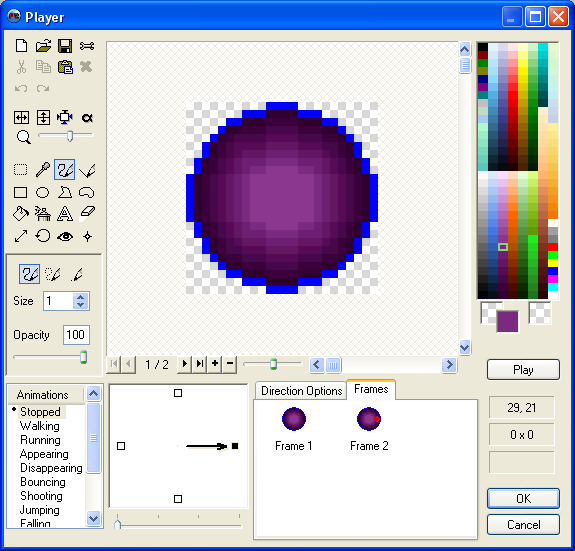
Under no circumstances would I want someone to be in a position where they'd need to use Pixelstudio. As far as I could find there are no tutorials on youtube.. probably because everyone would rather use photoshop or whatever else, but still. Don't use it. I don't know if I'm just using it wrong.. but there's no reason it should be that counter intuitive. But as far as I can tell unless you upload an image with color, there isn't a way to change the color scheme past black and white, or any easy way at least. If you cut an image and attempt to move it elsewhere, the dotted line that typically surrounds it will not go away, not easily. And whenever you try to draw while the dotted line is still surrounding your image your drawing will not place. It won't stay. You can't draw. The checkered "see through" background that you typically want to utilize for the edges of your sprites once uncovered, cannot (seemingly) be covered up again. The only way I could figure to fix these problems was by deleting the image I worked on and starting over. This isn't like the program has a million buttons either, it's only a step above mspaint as far as I see, but I couldn't figure these few simply things. Things that should be big and bold obvious fixes for even me. I know this sounds like user error, to a degree I trust it to be, but in school I picked up programs like Illustrator, and Photoshop pretty easily. Heck I had Premier functional in five minutes. Maybe I'm a special kind of dull, but really if programs as intricate as Illustrator/Photoshop and whatever else don't give me this much trouble, I'm just going to write up Pixelstudio as broken. If it's just user error, I'm fine with that, then all that means is the user interface is broken. Or at least it's broken for what we're looking for.

What we're looking for is something that's accessible from the start, that has multiple frame possibilities, and that's popular enough that anyone wanting to know more about the program for whatever reason can find what they're looking for in a five minute Google search. And as much as I'd have preferred if this was it, Pixelstudio is defiantly not that. For me at least. And what happens then is you fall back on what you know, regardless of how counter intuitive it might be.


So for now I've fallen back onto my old friend, MMF2's inbuilt sprite editor. Which is more then functional for my needs. It's completely economic for me, it's something I already have and know. Just sounds a bit odd. 

"Oh I'm making this game in AGS, it's really art asset heavy so I spend a bunch of time doing pixel art... No.. actually I use this sprite editor from a completely different game making program... Why aren't I making the game in that other program then? ... Because.. Because I like this editor."

So until I am as familiar with another program I'm just going to use this. 

Looks simple right? That's because it is. Unfortunately this isn't one of those free programs. Really sorry everyone. Honestly though, just use paint and remember to save as a png. That served me just fine for quite a while.. but, for me, with this I can instantly make a new frame with this one instead of saving, then drawing over, then re-saving. So for now I'm just going to work with this one. If anyone's interested in me looking into any of the other free paint programs or do help/tutorial bits on them, I'd love to. But for now I'm going to keep on task, plus no one reads this anyhow. :P

First I had this awesome idea for a gif. But then I realized... I don't even have an avatar for my profile in the forums.. That's sad. Heck, I don't have a personalized avatar anywhere. I just like my pictures of Koalas. God knows there's nothing wrong with that. Bless those little toxic rabid bunny bears.

So that's my first project. 120x120, animated, and see if I can get the level of artz that I see in my head for this project.

(I'll upload the original photo later)
So I messed around with my phone taking selfies, and feeling crap about myself the whole way...mostly because I was aware of myself taking selfies and that I'd have to divulge that fact to the world later here. And ended up with something I didn't quite hate. Then I decided to crop it in the image to leave out my nose. I like the placement of the head, the glasses going off the bottom. And now I just need to do a whole lot more work. This is kind of the first step. Thinking on it now, what I should have do is create a new frame every time I draw a new line/edited it. Then when I'm done I'll have a gif that captures the entire process, the journey is always so much more impressive then the actual finished product. As you can see on the left corner of the subject's brow I attempted crosshatching for the first time with pixels. Not actually bad from a distance, i'll have to experiment more. Bringing that up you can see that the light is actually oriented on both sides from behind the suspect, stronger on one side then the other. Also the eyes look slightly crooked, this is actually just my face being off. One ear is higher than the other so not only do my glasses sit on my face a little crooked, but I tend to hold my head on a slight angle.

My aim at the end of this is to have a realistic(ish) shading, get better at this crosshatch thing(because my project goes for a comic book aesthetics)...

My glasses actually aren't that massive, there about a size or two down in diameter. So.. like maybe three of four pixels smaller in diameter. And they're a little more oval. I have old person glasses, I find them classy. 

On that note I think I captured the distortion from the lens pretty well, it looks like that was what I was trying to do an not just me being bad at art. 

Anywho by the end of this I'd like to have a fully rendered face with some animation. Possibly a bit of background, or not. No, that'd be terrible. I'd like to mention very quickly that this stream of consciousness writing is for the soul purpose of the reader's benefit. My purpose is to show the process. And the process of every work --world changing or seemingly insignificant-- is a great deal of second guessing and consideration, it's also a great deal of, "yeah this is what I got.. it's not great right now, but I'm going to do more." and then doing all of that more until it's finished. It's be prepared to look unsure of youself, and less qualified to be speaking then others, and ignorant, and incompetent. It's being prepared to be sure in yourself enough to let go and show all of that fear and self doubt. To just go all out with what you love regardless of how it looks. Does a blind man dance for others or for himself?
... 
Alright, that's a little out there, what I mean is when you do something that's about creating, and having fun, and self therapy, other people watching you do it shouldn't even be on your mind. I'm not saying ignore people who enjoy your work or don't consider constructive criticism seriously, but don't loose the heart of the thing you love in the idea of others, they don't matter so much for you to have your favorite thing ruined.

.. what the heck was I talking about.

Oh right. I'm going to stick with the gray or similar simple background as a means to draw focus to the character, the animation in the fact of moving will not need help drawing focus. In design simplicity is kings. And the thirds rule is queen. And form over color and text. But be careful around graphic designers with that. We're a very opinionated people. Honestly though, it's form. Design an image like you're colorblind and can't read, focus on form, then add color.. and honestly I don't even know why they have text separately, technically the font is just picking shapes that will go on a page, that falls under the form.. Whatever, I only studied graphic design for a year at school, that's half the program at most, I'm not a real graphic designer. 

Now in my opinion as a stationary image and one that will be on a loop and animated avatar should have a circular animation rather then one that breaks. What I mean by that is say that I used the large empty space to the left of the subject's face and had a hand slowly raising a steaming mug of coffee, have it come to rest briefly, then go down below the screen. My issue with this that visually it's going from a "off" to a "on" position. Mug up->Mug down (repeat)

It's easily distinguishable and feels slightly fractured, it's not a complete smooth continuation of motion, the start and stop nature of it makes it distracting in the corner of the eye.. and to me irritating. It's like watching two bored slow children on a sea-saw, they don't care for it, it's boring, they're just doing it because they can. 

Now say the animation was the mug slowly raising from the bottom, coming to the middle resting for a brief moment, then the animation rest, the mug slowly coming from the bottom again. We see this commonly with reaction gifs. This have definitive ends to the animation and are more synonymous with visual jokes or a punch line. It's a visual sentence.. that gets repeated forever. In the forums this is typically fine behavior, and interesting subject. Banter creates humorous context between two people in a manner that's typically referred to later as "you had to be there" but than an image or emote that's typically mutually understood is used to embody the physical body language, and room dynamic, that might not otherwise exist on a text-form of communication. Text alone is nearly without context in comparison to the other forms of communication we're use to. So the gif can be a punchline for a joke in which you're always there for... unless you don't understand the reference that is. I think if you're introduced to the idea of gifs as part of everyday netchat you have enough context to understand it's (otherwise seemingly arbitrary) placement as a joke. Like you don't get the reference but typically you can see the humor regardless.

Like So


The difference here is that gifs are normally very quick and continue back into themselves instantly. As it is a continual flow of motion it is in a manner creating a visual circle. Bit of an awkward one --like a oval-- but circular non the less. The importance of having a circular animation is creating something that can remain stationary, continue moving, and still look natural. I'll go more into this later but the point is to have something that is dynamic and interesting while fading into the background. This is hugely important with designing idle stances for characters and for animated backgrounds (see I had a point all this time). You animate your background to make an ordinary room more dynamic or control the flow of transitions in room changes or event triggers.  But  you don't want to pull the player out of the experience or draw their attention away from the avatar in game. "Would you look at that, the lighting flashes from that same spot ever two minutes." The background should be just that, a background(unless it's a plot event) animated backgrounds when done well are fantastic, they aid the illusion of depth to your world and aid your player's sense of autonomy within that world. The player walks through a bush and that bush shakes as they pass, giving the player the sense their avatar is has mass and taking the shortcut through the bush instead of walking around was an actual choice and that the choice was meaningful. The best way a designer could emphasize the choice of going through the bush as different than walking around could be in lowering the avatar's speed as they pass through. Or if they pass through while running instead of walking, lower the speed while taking a small amount of damage. This all adds to the player's sense of autonomy, running or walking and where they run or walk is a choice that has repercussions. This sense of allowing the player autonomy while balancing games is what leads to a structure that allows the player to devise strategy and tactics. If a zombie was running at you, you might take the long way through the bushes slowly instead of running around so-that the zombie would follow you, taking damage and coming out of the bushes slowly giving you time on the other end to hack away at the undead mob. In starcraft steam vents shield units from radar, certain obstacles need to be attacked to be broken down, and ledges cannot be jumped. All of these make those elements of the world more real, and together form a tangible environment for the player.


I'm not animating my avatar because it's in a game though, I'm just doing it because it makes it look better, I don't have prior experience making gifs, and .. yeah. Night everyone. ^^

Good luck with your projects. 


So I'm making these things again.

So after not really being able to wrap my mind around code. I opted to step it back and start simple. Something I typically try but end up trying to sneak in more features then a program is flexible enough for. And by that I typically mean doing so meant a more code heavy revise than I could handle.. But I think I've found the right thing. And I think this might be the hardest thing for starting up designers (or those of us that have never finished a project on our own), you need to find tools that are simple enough for you to wrap your mind around using them to create your idea, and the tool has to look simple enough and be the least amount of threatening on approach that you don't feel intimidated and overwhelmed when learning.


And I was draw to ags initially the way I am typically drawn to something.. it was free. Spending the time to download and drudge through the tutorials is some of the best time I've spent. And I say that as a poor, currently under-slept, not quite starving college student. It's break right now for Christ sakes and I can't get myself to sleep in. I'm super excited to have one of my old designs not only off the back-burner (as I now have tools to slowly coax pages of scribbles into sweet digital life), but not just off the back-burner, but to see the tools at my disposal and realize how very doable this vision is. Often with a design orientation, you get an idea for something --and any good designer will tell you, it's not the thing that matters it's the manner in which it works, that makes a truly good design-- and when you don't have any training or understand the vocabulary of how your pen works(coding; in a manner of speaking) then you have the assumption your grand idea isn't possible and is too complex mechanically. And that's what I had thought for the longest time with many of my designs, so what did I do. I focused on the gameplay, the input output relations with the player and the essentials of what really made something. Because if I could figure that, and break a game down to it's smallest components, and then possibly get myself to the point of building those components, then I could design a project solely around that singular component, and then with time build on new features learn and work up to an engine that I could use to build the stories I wanted to.

Once to build a metroid-ish/brawl platformer I started the designs for five separate titles that slowly scaled back the functions of the game until the one I started working on was literally two frogs that could either step forward or backward and were fencing with their tongues. Like a dive kick game, but it's step forward or step backward kick. Attacking while stepping forward made a simple straightforward thrust. A backward step with a attack would make a sideways slash that could parry a hit. That was it. You would go forward in an attack or move back to defend. 

And really, I'll probably end up using that same strategy to make my final products, lord knows it'd help fill out the empty file designated for finished products.
Any finished product is a trophy in itself

But my point is, it's nice to know that the set of stairs that lead to your dream projects aren't always as massive as you think. Dream accomplishments aren't nearly as impossible as we think, the tasks are actually very human and legitimately possible.

And, my goal on this blog now.. along with using it to help keep me honest and frequent with my internship writing. Is to show off how possible these dream projects are. I've always been a massive fan of Wolfire Games' marketing strategy of showing start to finish because I know how much that meant to me when I was first thinking of game design. That sudden realization that follows being introduced to your deepest dream activity as a realistic profession, "Crap.. this could be what I do. Even if I need to do a second job, I could be doing this. I could be making those kinda things." That realization that game design and creation wasn't... it wasn't something so out of reach, not a "I could never do that.." situation. And when I first saw those games being made, when I followed the squares on screen betas turn to polished alpha releases, all of that just got me so excited. I spent.. well I haven't stopped thinking about games. Not just as a retreat, or pastime like they were before, but as my worlds. Instead of retreating into a book or movie or game like it was a favored place to be comfortable and be myself in, I started retreating into these as if they were close friends that whispered hints and tricks about how to excite the audience, make them laugh, or make them care. My notebooks at school actually started being used.

BACK ON TRACK

So, soon as I pull together the braincells to figure out fraps.. (probably lost half the audience, I swear I'm not completely incompetent), I'll record myself working on this project. Possibly do a tutorial session about everything that goes wrong and how to trouble-spot where you're going wrong.. because I think I've run into almost all of the most basic ones and in trying to find what's wrong realized there isn't a single person on the internet who was simple enough to make the same ignorant mistakes I've made. Thus far I've figured all the problems I've run into by myself (I'm very proud). There will undoubtedly be more in the future. But for now I'm going to upload and dictate my design process, both selections from my notebook on how I'm mapping and keeping track of the perspectives. And mentions of what I learn, as I learn the AGS editor and coding tips and hints.

-My first error, which was one of the most frustrating, was the room I had created was unable to load the background image I had drawn for it. Which was frustrating because I'd go back and forth between the general settings and the image I had made because they were the same size, pixel for pixel; and the computer told me they weren't. The issue had been, of course, the room actually wasn't the same size as the general setting, this was because after I had made the first room I changed the general setting size. This was because I made the room, checked the size, looked at my image editor and realized I wanted it bigger. The rooms are built off the general settings but once built isn't linked to those general settings anymore. The resolution does not bend back and forth to my will in these separate rooms. So basically all I did was delete the room, remake it, and the image worked. That took me two days to figure out. I want you to see me in all my pathetic glory so when I have something to show and you're first reaction is "meh, alright.. that's kinda neat." You'll see how far I've come.

-And here's my coup de gras, or at least I hope it's the most facepalm I get learning this... Facepalm.. Facepalm Games.. that's what I should call my youtube development videos! You see you have to find a way to make it fun, you even have to make losing fun, with my history of game making, this is going to be a whole lot of fun.
My coup de gras was I couldn't get the inbuilt editor to draw walkable areas. I'd select every tool in the little bar, draw rectangles, draw line tool, draw pen tool, and all those other things.. I don't know what do.. But anytime I'd try to draw on the page it'd tell me that I couldn't do that, that I had the eraser selected. And I'd get very upset because I didn't. And it was saying crap about a properties plane, and I couldn't find what they were talking about. It made me very upset, but I had seen the light at the end of the tunnel.. this was possible and this design has been brewing in my head for almost two years, the functions I thought I couldn't do and the art-style had been brewing for four years, and that functionality was literally a number of months of work away. It was possible, I was just being ignorant, and I'd make it work. Enter roughly four days of doing almost nothing but fart around on my computer trying different things on the editor and having five tabs open looking through basic tutorials later I realized I had the properties of the room set on Walkable Area 0... as in no walkable area at all. Meaning I wasn't drawing.. which would automatically set the pen to a function that wouldn't work. 
  

No matter what you start learning, you will always start off making mistakes you will laugh at in the future. So enjoy it, realizing painful ignorance is the universe's way of making learning fun.

My next hurdle.. along with everything coding. Is to find a good paint program to get the kind of pixel art I'm looking for. So far I'm using Sketchbook Express 2011, and with some farting about I might be able to get the precision stuff that I want but right now the settings are giving a difficult to control --as it's designed for tablet and pen(a set i don't really have)-- and faded soft brush effect in the lines. And.. well I'm looking for more pixel accurate hard color effect. Plus this isn't a program everyone can download. So I've downloaded and will come up with a review for PixelStudio next post along with more on the Island.

Goodnight everyone, good luck with your projects.