Showing posts with label Art. Show all posts

Wednesday, October 15, 2014

Pixel tutorial

My ability to draw has always been hit or miss, I had fundamental classes in high school and would occasionally doodle, but always avoided the human figure because of its difficulty. And I still find it so, probably always will. But through doodling and what I retained from the classes I've taken so far in drawing I've picked up a few hints that helped.

1. Practice/mentality, it's a duh moment but it's true. Most important though is to practice the right way. When you're just drawing things off the top of your head and you're having trouble making them look photorealistic or "life like", then I suggest trying to draw something out of a photo. This isn't tracing, this is exercising the eyes' ability to notice and the hands' ability to translate that. Drawing is 99% in the head, and 1% in the hands and eyes. If you can see it, you can draw it as you see it. Where you start doesn't dictate where you end up. The trick is to exercise that link between the hands and eye. Seriously, anyone can do it. To quote Garfield from the animated series Garfield and Friends, "it's just lines on paper." And that is unarguably all it is, just like how paintings are just paint on canvas. And it's not in any explicit way of how that paint is put on, there isn't any technique or way to move that dictates how well the lines end up looking. It's in seeing what the lines do, and recognizing what that means in relation to the piece as being presented as you work, and keeping that in mind as you work. What this means is as simple as "that line on his ear comes in too far, makes his ear look too big".  And then making the line come in a little. That is literally all drawing is. A bunch of that one, line and alteration after the other until you feel happy with it. Reason experienced artists make it look so easy is they've exercised that hand/eye/brain coordination so much they can more quickly approximate what they see in their head on paper, where with the rest of us faces start off looking vaguely potato-ish, they know how to draw the right face shape from practice. Just like those pieces you see the tourists artists do in no time at all that come out looking good, they've practiced how to make what they see so often their hands just know what to do.

Now, I like pixel art for two reasons. First because regardless of how many mistakes I make the canvas doesn't show so I always feel in control of the finished product, and secondly because there is a total abandon within having definite color and space. I can pick this or that pixel to color, but no where in-between. I have a limited pallet and can only attempt to replicate a degree of what colors exist in real life. While, say, this image


has a massive number of shades of grey and very specific locations for the white flakes in his hair, I cannot hope to perfectly replicate that, but in pixel art I can approximate it. It will never be perfect, Wittgenstain is made of smooth edges and not squares, as is the tradition of pixel art I'm only using two colors to highlight the pixelness of it.  
  
2. The flatland. (I actually meant to have more photos showing my progress before this step --will do next time-- but I got distracted. )


This second aspect to art I want to use these early saves to illustrate. Make things flat. People often think they aren't arty enough to get the angles on a room just right and make 'depth' or just can't get the proportions right to make something look... not deformed. But the fact that your eye is able to pick up that you're work isn't 'right' just yet means you have the capability to notice what is off, with is all it takes with diligence and slight alterations to make something looks right. The easiest way to approach this is to flatten things. Drawing still life or things laying around the house is really hard because as you look back and forth you wind up moving your head slightly and because of your perspective the angles on the piece change. You end up constantly altering the proportions of the piece. With practice you can learn to avoid this. But for beginners or those trying to get a bottom up refresher of their abilities(which every artist should do occasionally, imho), start drawing things from photographs. Next is to break the image down into less complex shapes and distances. 'The eye is ovalish, half way down the head, a little squared over here..' ect. This is the same for the negative space. Instead of seeing where to put that tiny ear in relation to all this white, imagine figuring how to fit this large triangle thing between the shoulder and the ear. 'Okay it comes up to a little higher then half the image, bends right below the ear here and slightly closer towards the neck down here.' Start by building your basic outline and move in. Remember to strictly avoid detail work at this point, you're getting the layout of the image. Start sharpening the edges of that layout.


3. Details. Treat every detailed spot like you approached the general layout, start with the big stuff. 'this spot is all black' 'this corner is more rounded' 'this has little hairs sticking up' and then move onto more intricate stuff.
 (As a side note somewhere in the above I said there is no direct technique that leads to how a piece turns out. I kinda lied, the grey stuff is dithering, it's a technique of spacing squares in a checkered or 'cross' pattern to replicate shading. It's a way to keep the pallet color down while simulating shading, similar to crosshatching as seen in comics/print. )

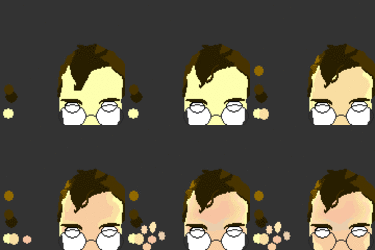
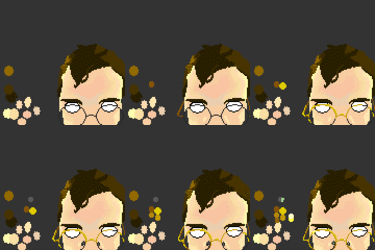
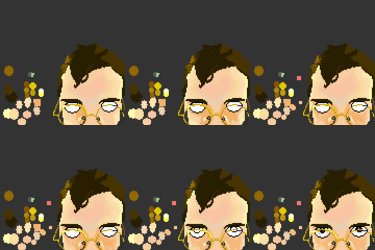
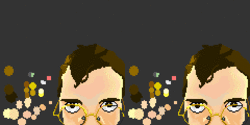
The rest is the back and forth, glance at the reference picture, make a decision how to shade/represent what is there, look at the image see what could be wrong. When you are at this point getting a pair of outside eyes can be very beneficial, also looking at your piece from different angles i.e. turning the image and canvas upside down. Replicating something upside down is a common experiment in early drawing classes and I recommend it, by having a face upside down the brain doesn't so easily recognize it as a face and allows you to more easily see it for it's angles and edges. About here a talented artist friend of mine mentioned how not only was the chin far too thin, but the neckline doesn't go in so drastically, that the whole left shoulder (in relation to viewer) was in too far. Within the next three panels I work on correcting that along with other slight alterations with the eyes and brow. Then carry on to darken the dithering on the other side of the face, make slight alterations to the hair, and work more on the eyes. Click on the first image to be able to cycle through the images without seeing the text to see the changes better side by side.


A great way to break down the shading in a piece, especially a monochromatic, is to squint at it. Or in my case take off your glasses. The details get lost but suddenly the overall shape and shading becomes more clear (in a manner of speaking). A pixel art piece of an image is in a way already a blurred/distorted version of your image, so when you squint and compare the too your eye will better see the features that translate and more importantly where they don't. Try it out: comparing the bottom two, the original image and my piece you'll notice the bottom Wittgenstein's nose is much darker, that there's less shading on his left ear, and that his chin doesn't extend quite so long. With open eyes of course his left eye needs work, it's not clear where his eyeball and eyelid start and stop as it is with the right eye.


You'll notice the comparison is far from 1-1 but it is an approximation. There are light spots I couldn't figure out how to represent near the right side of his temple that I excluded altogether. The dithering more lends itself to suggesting the details and shapes of the face then replicate them. Now the point of this exercise specifically, to attempt to approximate another image (instead of simply creating an image from imagination) is that this teaches the eye how to see in terms of simple things like lines instead of difficult things like faces, and it teaches the mind how to use your medium in approximating certain effects. When your mind and eyes think in terms of the medium you use and you will be better able to clearly imagine a creature in a way to translate it to the paper... or screen.
Until next time, thanks for your time, good luck on your art and goodnight everyone. 


Thursday, February 13, 2014

Valentines DeconstructionCraft- Games and Romance

 (click to take me to article)
(click image to go to article)


So as this Friday-tomorrow- is Valentines day Kevin of NextLevelGamingOnline's DeconstructionCraft and I wrote a combined piece on romance devices as they're represented in video games. Unfortunately the site doesn't actually acknowledge two authors so we had to include that bit in text, but that's fine. My bit builds of Kevin's work and introduction but if you're just interested in skimming mine is the second half. Kevin references Final Fantasy 7 and 6, along with Second Life. I comment on relationship mechanics as they're used in the Sims, Catherine, DragonAge, Animal Crossing, Mass Effect, Harvest Moon, The Marriage, and Ico.

Monday, January 13, 2014

What makes a thing that has pixels "Pixel Art"?

I'm going to site a particular moment from the AGS forums for you. Because it was an important moment for me where it fully clicked, when it comes to sprites, images, resolution, and some of the other terminology that makes sense of images we use in digital art.

My previous draft  (as recorded in this post) for creating my own pixel art avatar gif was thus 

Unfortunately

"I think the palette is okay. But if I were to be really literal here, this is NOT pixel art. You are using merging gradients and soft brushes, both of which are not used in traditional pixel art. See also here: http://www.pixeljoint.com/forum/forum_posts.asp?TID=11299"

By god this is better criticism then I could have hoped for. I say that in all sincerity, I'm a newbie --sure I know the kind of results I want to end up at-- but I have no idea of how to get there. I had seen some examples of this dithering thing that's used for shading, but once that got a little complex went right back to what I know. Using a crap ton of gradients. This soft transition from one shade to the next almost makes the use of pixels invisible. Which entirely misses the point of pixel art, high amount of control and focus on the pixel as the tool, and as a visible tool used in the art. I seriously encourage anyone whose looking into making games and especially people who want to do art for their games to give this a serious read

So along with a great amount of insight from that article on how do do this art and such, note the valuable examples of styles of dithering, the commentary on anti-aliasing, jaggies, and --one of my personal favorite technique errors-- pillow shading. Also understanding the difference and --more importantly-- proper use of hue, saturation, and luminosity. In all honesty I had kind of forgotten the difference between hue and saturation.. mostly just because I forgot what hue was, saturation is pretty self evident. I had basically just dragged the mouse around on the color finder until it was slightly darker or lighter. I feel stupid about getting them confused. I mean, I've learnt this, this. No point in focusing on the negative. So what to do. Well I'm going to change the color scheme ^^. The issue I was having from the get go was trying to get the exact right amount of red or yellow in the skin tones. And, while with more time it might be possible for me to get this to the realistic(ish) style I was aiming for, diving into full color scale is me diverging from my original goal. I wanted to practice dithering and shading, I wanted to achieve a level of believably with a strong pixel art approach. I wasn't going for photo-realism, I wanted a believable rendering, but believable and photo-realistic are two entirely separate beasts. So to focus on learning dithering I'm going to cut it back to a bichromatic palette.  

That's the plan, I'm going to get to work. Good night everyone and good luck with your projects.    


Sunday, January 12, 2014

How to Gif.. Please really how?

Alright, so I've gotten significantly farther with my avatar... this is going to take a while. And I've got some of it animated for you ^^ which is making it take even longer.


Current stage


By god, I am never using that gif maker again. I used Picasion's free online, "insert only ten files" crap. The last one is actually two frames. behh. If anyone knows freeware gif/animating program that's a legitimate option for this kind of thing please throw me a recommendation in the comments below or a message, anything really. Well, I'm really tired and it's a nice time in the morning to go to bed. So goodnight everyone. I know this was a lackluster post. I'll was looking up a bunch of pixel stuff and I have some links and tell you what I've learned from dicking around with them later. As always, good night and good luck with your projects.

Saturday, January 11, 2014

Pixelstudio Review and Pixel art/animation(a little bit).

Under no circumstances would I want someone to be in a position where they'd need to use Pixelstudio. As far as I could find there are no tutorials on youtube.. probably because everyone would rather use photoshop or whatever else, but still. Don't use it. I don't know if I'm just using it wrong.. but there's no reason it should be that counter intuitive. But as far as I can tell unless you upload an image with color, there isn't a way to change the color scheme past black and white, or any easy way at least. If you cut an image and attempt to move it elsewhere, the dotted line that typically surrounds it will not go away, not easily. And whenever you try to draw while the dotted line is still surrounding your image your drawing will not place. It won't stay. You can't draw. The checkered "see through" background that you typically want to utilize for the edges of your sprites once uncovered, cannot (seemingly) be covered up again. The only way I could figure to fix these problems was by deleting the image I worked on and starting over. This isn't like the program has a million buttons either, it's only a step above mspaint as far as I see, but I couldn't figure these few simply things. Things that should be big and bold obvious fixes for even me. I know this sounds like user error, to a degree I trust it to be, but in school I picked up programs like Illustrator, and Photoshop pretty easily. Heck I had Premier functional in five minutes. Maybe I'm a special kind of dull, but really if programs as intricate as Illustrator/Photoshop and whatever else don't give me this much trouble, I'm just going to write up Pixelstudio as broken. If it's just user error, I'm fine with that, then all that means is the user interface is broken. Or at least it's broken for what we're looking for.

What we're looking for is something that's accessible from the start, that has multiple frame possibilities, and that's popular enough that anyone wanting to know more about the program for whatever reason can find what they're looking for in a five minute Google search. And as much as I'd have preferred if this was it, Pixelstudio is defiantly not that. For me at least. And what happens then is you fall back on what you know, regardless of how counter intuitive it might be.


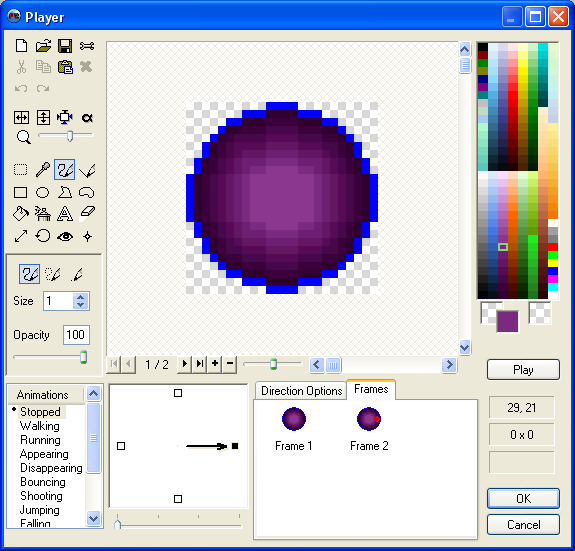
So for now I've fallen back onto my old friend, MMF2's inbuilt sprite editor. Which is more then functional for my needs. It's completely economic for me, it's something I already have and know. Just sounds a bit odd. 

"Oh I'm making this game in AGS, it's really art asset heavy so I spend a bunch of time doing pixel art... No.. actually I use this sprite editor from a completely different game making program... Why aren't I making the game in that other program then? ... Because.. Because I like this editor."

So until I am as familiar with another program I'm just going to use this. 

Looks simple right? That's because it is. Unfortunately this isn't one of those free programs. Really sorry everyone. Honestly though, just use paint and remember to save as a png. That served me just fine for quite a while.. but, for me, with this I can instantly make a new frame with this one instead of saving, then drawing over, then re-saving. So for now I'm just going to work with this one. If anyone's interested in me looking into any of the other free paint programs or do help/tutorial bits on them, I'd love to. But for now I'm going to keep on task, plus no one reads this anyhow. :P

First I had this awesome idea for a gif. But then I realized... I don't even have an avatar for my profile in the forums.. That's sad. Heck, I don't have a personalized avatar anywhere. I just like my pictures of Koalas. God knows there's nothing wrong with that. Bless those little toxic rabid bunny bears.

So that's my first project. 120x120, animated, and see if I can get the level of artz that I see in my head for this project.

(I'll upload the original photo later)
So I messed around with my phone taking selfies, and feeling crap about myself the whole way...mostly because I was aware of myself taking selfies and that I'd have to divulge that fact to the world later here. And ended up with something I didn't quite hate. Then I decided to crop it in the image to leave out my nose. I like the placement of the head, the glasses going off the bottom. And now I just need to do a whole lot more work. This is kind of the first step. Thinking on it now, what I should have do is create a new frame every time I draw a new line/edited it. Then when I'm done I'll have a gif that captures the entire process, the journey is always so much more impressive then the actual finished product. As you can see on the left corner of the subject's brow I attempted crosshatching for the first time with pixels. Not actually bad from a distance, i'll have to experiment more. Bringing that up you can see that the light is actually oriented on both sides from behind the suspect, stronger on one side then the other. Also the eyes look slightly crooked, this is actually just my face being off. One ear is higher than the other so not only do my glasses sit on my face a little crooked, but I tend to hold my head on a slight angle.

My aim at the end of this is to have a realistic(ish) shading, get better at this crosshatch thing(because my project goes for a comic book aesthetics)...

My glasses actually aren't that massive, there about a size or two down in diameter. So.. like maybe three of four pixels smaller in diameter. And they're a little more oval. I have old person glasses, I find them classy. 

On that note I think I captured the distortion from the lens pretty well, it looks like that was what I was trying to do an not just me being bad at art. 

Anywho by the end of this I'd like to have a fully rendered face with some animation. Possibly a bit of background, or not. No, that'd be terrible. I'd like to mention very quickly that this stream of consciousness writing is for the soul purpose of the reader's benefit. My purpose is to show the process. And the process of every work --world changing or seemingly insignificant-- is a great deal of second guessing and consideration, it's also a great deal of, "yeah this is what I got.. it's not great right now, but I'm going to do more." and then doing all of that more until it's finished. It's be prepared to look unsure of youself, and less qualified to be speaking then others, and ignorant, and incompetent. It's being prepared to be sure in yourself enough to let go and show all of that fear and self doubt. To just go all out with what you love regardless of how it looks. Does a blind man dance for others or for himself?
... 
Alright, that's a little out there, what I mean is when you do something that's about creating, and having fun, and self therapy, other people watching you do it shouldn't even be on your mind. I'm not saying ignore people who enjoy your work or don't consider constructive criticism seriously, but don't loose the heart of the thing you love in the idea of others, they don't matter so much for you to have your favorite thing ruined.

.. what the heck was I talking about.

Oh right. I'm going to stick with the gray or similar simple background as a means to draw focus to the character, the animation in the fact of moving will not need help drawing focus. In design simplicity is kings. And the thirds rule is queen. And form over color and text. But be careful around graphic designers with that. We're a very opinionated people. Honestly though, it's form. Design an image like you're colorblind and can't read, focus on form, then add color.. and honestly I don't even know why they have text separately, technically the font is just picking shapes that will go on a page, that falls under the form.. Whatever, I only studied graphic design for a year at school, that's half the program at most, I'm not a real graphic designer. 

Now in my opinion as a stationary image and one that will be on a loop and animated avatar should have a circular animation rather then one that breaks. What I mean by that is say that I used the large empty space to the left of the subject's face and had a hand slowly raising a steaming mug of coffee, have it come to rest briefly, then go down below the screen. My issue with this that visually it's going from a "off" to a "on" position. Mug up->Mug down (repeat)

It's easily distinguishable and feels slightly fractured, it's not a complete smooth continuation of motion, the start and stop nature of it makes it distracting in the corner of the eye.. and to me irritating. It's like watching two bored slow children on a sea-saw, they don't care for it, it's boring, they're just doing it because they can. 

Now say the animation was the mug slowly raising from the bottom, coming to the middle resting for a brief moment, then the animation rest, the mug slowly coming from the bottom again. We see this commonly with reaction gifs. This have definitive ends to the animation and are more synonymous with visual jokes or a punch line. It's a visual sentence.. that gets repeated forever. In the forums this is typically fine behavior, and interesting subject. Banter creates humorous context between two people in a manner that's typically referred to later as "you had to be there" but than an image or emote that's typically mutually understood is used to embody the physical body language, and room dynamic, that might not otherwise exist on a text-form of communication. Text alone is nearly without context in comparison to the other forms of communication we're use to. So the gif can be a punchline for a joke in which you're always there for... unless you don't understand the reference that is. I think if you're introduced to the idea of gifs as part of everyday netchat you have enough context to understand it's (otherwise seemingly arbitrary) placement as a joke. Like you don't get the reference but typically you can see the humor regardless.

Like So


The difference here is that gifs are normally very quick and continue back into themselves instantly. As it is a continual flow of motion it is in a manner creating a visual circle. Bit of an awkward one --like a oval-- but circular non the less. The importance of having a circular animation is creating something that can remain stationary, continue moving, and still look natural. I'll go more into this later but the point is to have something that is dynamic and interesting while fading into the background. This is hugely important with designing idle stances for characters and for animated backgrounds (see I had a point all this time). You animate your background to make an ordinary room more dynamic or control the flow of transitions in room changes or event triggers.  But  you don't want to pull the player out of the experience or draw their attention away from the avatar in game. "Would you look at that, the lighting flashes from that same spot ever two minutes." The background should be just that, a background(unless it's a plot event) animated backgrounds when done well are fantastic, they aid the illusion of depth to your world and aid your player's sense of autonomy within that world. The player walks through a bush and that bush shakes as they pass, giving the player the sense their avatar is has mass and taking the shortcut through the bush instead of walking around was an actual choice and that the choice was meaningful. The best way a designer could emphasize the choice of going through the bush as different than walking around could be in lowering the avatar's speed as they pass through. Or if they pass through while running instead of walking, lower the speed while taking a small amount of damage. This all adds to the player's sense of autonomy, running or walking and where they run or walk is a choice that has repercussions. This sense of allowing the player autonomy while balancing games is what leads to a structure that allows the player to devise strategy and tactics. If a zombie was running at you, you might take the long way through the bushes slowly instead of running around so-that the zombie would follow you, taking damage and coming out of the bushes slowly giving you time on the other end to hack away at the undead mob. In starcraft steam vents shield units from radar, certain obstacles need to be attacked to be broken down, and ledges cannot be jumped. All of these make those elements of the world more real, and together form a tangible environment for the player.


I'm not animating my avatar because it's in a game though, I'm just doing it because it makes it look better, I don't have prior experience making gifs, and .. yeah. Night everyone. ^^

Good luck with your projects. 


Tuesday, August 7, 2012

Christoph Hartmann's "Photo Realism" Interview Response [E]

Author's note - the promised episode is on its way, but current events are current so.. here.

PROLOGUE


I first heard of the interview with Christoph Hartmann ,the head of 2K games, interview about 2K and 2K's views on the future of the industry that resulted in Mr. Hartmann's comments about Photorealism from the Jimquisition on the Escapist Magazine. But before I let my artzy fartzy designer side of me start ranting I did some searching and found the full interview. Give it a read. To be fair to Mr. Hartmann I'm going to include both the question and his answer from Gameindustry.bliz with each of my responses.

 
INTERVIEW RESPONSES

The interviewer, Gamesindustry US editor, James Brightman goes through the interview asking the general future of the industry type questions and for the most part Mr. Hartmann gives pretty standard (in my opinion, non-committal) answers. About two thirds through the interview though are where alot of people starting to disagree with Mr. Hartmann.


MOBILE GAMING: CONVENIENCE VS QUALITY? 

James BrightmanOn the mobile front, a lot of traditional publishers have been having a hard time adjusting to that market. EA has done well, and Activision recently launched a mobile brand, but how does 2K look at tablets and smartphones? Is that going to be a big growth opportunity for you at some point?

Christoph Hartmann - It definitely is a platform and area that we are looking at very closely. If you look at Civilization, it was one of the best-selling games on the iPhone and iPad. We definitely are committed to that area of the business. We're definitely looking at other IPs that we have to see if they work on mobile. We're not just going to take some random IP and throw it on there. We're going to make good games, and we're also looking at doing something original one day.We don't think it will be a revolution to the business, though. No one will ever be able to replace the power of the console business - having a console with that power and the opportunities for quality games is very important. And while being able to pick it up and being convenient is a big thing, and your phone and calendar are there, playing and carrying around games is nothing new. It will be a larger part of the market, but it is not the holy grail of the market and the business. Look at the history, there is a place for everything, but I don't think anything is ever going to replace the consoles given the maturity of the market.


Response -  Alright... well sure being able to play and carry around games is nothing new, but the fact that we're not only talking Nintendo while doing it is. Nintendo has dominated the handheld market and nothing has been able to compete simply because pushing a new device to compete against Nintendo in the mobile game market that's just about been branded Nintendo Territory was inconceivable. You bought Nintendo handhelds because you were looking for the IPs that you've loved and the handhelds could constantly support that kind of game style its demographic was nostalgic of and, in relation to the rest of the industry, starved of. Secondly Nintendo has a solid reputation as completely family friendly, parents want an mobile entertainment for their children that they know will put out plenty of games they consider age appropriate. That was a business model you just could not compete with. But to introduce gaming to an already universally used and owned mobile device, finally with software capabilities that can stand up in that market, you've just revolutionized the industry.
Mobile games brought in an entirely different demographic to the industry and also brought back more of the older game styles; arcade rail shooter, side scroller, shoot'em up, and brought new ones that designers would never have considered feasible in the market to the mainstream. The Indie industry had an entirely new platform that was easy to attain and approach for design and innovation, the old school styles of play and throw back gameplay that the indie crowd had always catered to were suddenly in the attention of a larger demographic then ever before. App mobile games are one of the most affordable way for large and small studios to make creative innovative risks. If you're wondering what kind of art an app game could bring to the industry then just take some time looking at Super Brother's Sword & Sworcery. Mobile games re-energized the industry, bringing back the lessons early designers had been forced to discover to get around because of their technology's limitations.
The largest point of this argument though that I will press though is that the amount of material and capabilities put into a game do not define it's quality. Some of the greatest moments in gaming have not been built because of flashy new technology, they've been built by designers and writers who have worked together conscience of the resources at their disposal. It was about working around your limitations to make the best experience possible. To quote Stranger Then Fiction, 
"... who in their right mind in a choice between pancakes and living, chooses pancakes?"

"Harold, if you pause to think, you'd realize that that answer is inextricably contingent upon the type of life being led... and, of course, the quality of the pancakes." 
The metaphor being living as these massive budget, visually and mechanically impressive works. And the pancakes being a smaller work with a stronger design and execution. 


DEATH OF THE CONSOLES: SLOW AND AGONIZING 

James Brightman - I met with David Jaffe at E3, and he said that he thinks consoles will become dinosaurs after the next generation. He says next generation is probably the last generation now that things are going digital with smart TVs and cloud gaming. It sounds like you disagree completely with him?

Christoph Hartmann - I semi-disagree with him because the way your games are going to get transmitted from one source to the gamer might change, but I'm talking about big, huge quality games. It is like how people consume food. Fast food is on the rise and that has to do with our lifestyle, but there are high quality restaurants that are not going away. When I talk console games, I'm talking about huge experiences with many hours of gaming... and you will always need a major platform for those titles.
I don't know what we will have in the future, maybe a PS 15 or something, but we will need the hardware. It's like in the software industry, the software pushes the hardware; there's a give and take and it's the same in video games. We need machines built to perform well in one area, and that is gaming. You're never going to be able to compete with it because it's about quality and it's built to do one thing best. And, by the way, the whole streaming and cloud thing is just nice words until the [internet infrastructure improves]. I don't believe in cloud gaming until a cable provider stops breaking my internet connection every morning, when everyone logs in at the same time. I don't see this being fixed for a long, long time.


Response - Well, again, quality is not defined by the tech under the hood. Technologically impressive games come out all the time and no one even bats an eye, in this era change and technological improvement is common place, the true drive is always within the new use of technology. In this media technology has opened up thousands of possibilities, but it's the use of that technology that creates engaging experiences. With physical distribution production costs so high publishers are slow to greenlight anything that's not similar to whatever has recently been the most profitable on the mainstream market. That's not a recipe for a innovation, that leads to stagnation. With the digital distribution market growing so rapidly due to a better retail situation and infinitely better convenience eventually the consoles as we know it today will becoming obsolete. Notice how the newer generation consoles are trying hard and harder to be more then just a gaming console, it's because companies just can't get customers to justify paying the prices the companies want for something that's just another game system. How exactly and to what extent digital distribution will eventually change the video game industry we just can't know. We've only begun to grasp the full implications and possibilities of an internet hook up with multiplayer, look at Dust 514 and Eve online. The shift to fully digital gaming will for better or worse completely change the landscape of gaming, and the changes in the industry thus far because of it are just the tip of the iceberg. 


VIOLENCE IN GAMES AND BETTERING THE MEDIUM: PHOTO REALISTIC

James Brightman - What's your reaction to Warren Spector and his talking about how today's games are overly saturated with violence? Obviously, a lot of games in the 2K portfolio have plenty of violence in them. Do you think developers should be working to make other types of games not steeped in violence to help the maturation of the medium?

Christoph Hartmann - It's something that comes up internally a lot and in product development. What's the difference between the movies and gaming? Movies you just watch. You get emotional involvement in both, but in gaming you interact. That limits you already in what you can do, as certain emotions can't be recreated. Recreating a Mission Impossible experience in gaming is easy; recreating emotions in Brokeback Mountain is going to be tough, or at least very sensitive in this country. It's limiting. Comedy is already very hard in video games. You can't have a game simply built around comedy. It has to be part of an overall vibe. So there is only a certain area that you can use [to create games] and then you look at technology, you can kind of maybe make people look right, but it will be very hard to create very deep emotions like sadness or love, things that drive the movies.

Until games are photorealistic, it'll be very hard to open up to new genres. We can really only focus on action and shooter titles; those are suitable for consoles now. If someone comes up with a video game where it's all about you falling in love, where you have the emotions and you don't need a lot of interaction from your device, that's great but what happened to those interactive movies from the '90s? They were boring. It was like a movie that gave you three endings.


Response - The notion that only with a fully photo-realistic range of facial and body expressions that games will reach their full potential as a medium is.. well, it's ignorant to the theory, maybe even law, of all other forms of artistic medium. First in defense of non-photorealistic visuals, I'd like to site the entire animated film industry. Disney, there, how was your feels trip? This argument's over... right? Well no, simply because we feel we know something and we feel that examples we bring out prove the opposition wrong doesn't mean we've won. What we need to do is explain and understand the phenomena beneath our stand at its base. We know it's right, but we need to understand why it's right. Which for games (as a fledgling medium) might seem difficult, but lets be honest it's only difficult if we're lazy. Hundreds of years of arts have built up to this interactive medium, there is no other form of storytelling and expression that can take and adapt from more other existing forms to creating unique experiences.

LET'S GET STARTED
To understand a game as art, you first have to view it as art. You have to notice all the elements that go into it that create a completely unique experience in relation to other mediums, and in that you just can't relate it to other medium because they don't measure off the same theory in design. Art, at its root, is expression, but here's a better definition for our purposes. Art is the expression of real world beauty through the artist's interpretation. Meaning that all works of art are simply an interpretation of reality.

A QUICK MOMENT IN ART HISTORY
Pablo Picasso as child prodigy could draw photorealism (as the eye sees it) from the age of eight. It was within his later works that made him famous where he played with proportion and his representation of reality. Art has never truly been about replicating reality in the world, it has been about how to represent the beauty of the world. It's in interpretation, not replication, where an artist can really convey emotion to the viewer. Look at these two...

Which of these two stand out stronger, which seems to stimulate more, which makes you think and feel more?

BACK ON TRACK: CONVEYANCE   
The human mind and perception is a wonderful thing, we can look at proportions and representation of a human figure that is completely unnatural within the human world and still understand it to be human. Even in giving inanimate objects human like features we can mentally connect with the work as a representation of ourselves.

Exaggerated human like features and expressions prove to still powerfully convey emotion. With this phenomena the full range of human emotions can still be powerfully conveyed within an unnaturally proportioned representation. The catch is how accurately they can represent (not replicate) the emotions and convey the emotional situation to the audience.


UNCANNY VALLEY
Course, there is a powerful downfall to this phenomena, the Uncanny Valley. Teddy Bears were an instant hit, not because they looked like bears and were named after a popular president, but because their proportions were based of human babies. The slope is where proportions or expressions are close.. but just off in the wrong way. Then it becomes just creepy or unsettling and all feeling of connection or empathy with the subjects are completely lost.

Just... look..

Which one wants to watch you from outside the window and hug your dog too tightly?

CONCLUSIONS
It's in understanding all these things and all the subtle aspects of human interaction, and then taking those into account throughout the entire design and production process that video games can accurately portray strong emotions through the characters. They don't have to look like snapshots of reality, they have to look like snapshots of real life interaction.

It can be something as small as characters holding hands.


And without looking at the graphics, or even getting a glimpse at the faces, that connection between the characters are conveyed.

We can see those emotions and we understand them as a representation of our own feelings, we can empathize. We could create a Brokeback Mountain for gaming, but the reason we probably wont right now is more because of the political environment then our technology. When there are things like Chick-fil-A going on, how many producers would greenlight something like that? For this medium to transcend purely entertainment and to become an art we first have to have an industry that sees itself as creating art. It doesn't have to mean all art-house kind of games but more that are made by designers that see themselves as artist, in their own sense, within a creative medium. If we don't think we can achieve a status of art yet, then we wont be looking for a means to.

IN HARTMANN'S DEFENSE
In Hartmann's defense, as far as he's concerned, you can't convey a true range of emotions yet. In a market where shooters are the one reliable project to return a profit, how often does a designer really get a chance to explore a range of emotions? The largest demographic of the market want first person, and in first person as you are looking through the eyes of the character you might expect -to a degree- the world to look photo-realistic, as the eye sees it. The main demographic is white hetrosexual males ages from high school to college, the demographics are growing to include more then that sure, but still at this time what the industry produces is still generally governed by the most marketable items to that demographic. Violence & fighting, guns, sexual pandering, you get the picture. Then how do designers break this mold?

Well, actually they do it by not breaking it, they stretch it. They use what is popular to create art and expression in the game experiences they mold. Like basically, all other artists... Sure we haven't figured it out entirely, but no medium has, and we are learning. Take a look at the outcome thus far.  


In our own manner we have created art, we've conveyed true emotions and characters that the player connect and feel empathy for. And we've been doing it for a long time, we can't look at other mediums for comparison; because we have plenty of amazing moments in gaming history that convey powerful experiences to the player, those moments are what we have to learn from to better our medium and the emotional experiences we convey to the player. And that's just about all I can say on that. Until next time, thanks for tuning in everyone. If anyone has any comments they'd like to add to the discussion, feel free.