Showing posts with label review. Show all posts

Thursday, February 20, 2014

THIEF - Launch Trailer Thoughts/ Discussion on Stealth


In all honesty small response bits aren't my thing, but I figure as my commentary on design and production come from my personal experience with games I enjoy and making games I'd enjoy I thought it'd be good to include that other end of the spectrum. Traditionally indie development blogs showcase the creator's specific thoughts or commentary on whatever aspect of game creation they're currently working on, but they can also showcase examples of successful handle..ings of whichever specific content. The thief series is one of those good examples in a number of different design aspects. One of my personal favorite where it shines is "How to deal with open world without having the npc's become background fodder." or a little more face value "How to make engaging stealth." We're going to look at the latter for now.


One of my favorite aspects the stealth game -especially one of the former Theif series-  provides is this sort of player distinguished challenge. In stealth games the player has the option to wait and avoid detection, even if combat is imbalanced or the ai is boring, the ability to wait completely changes the dynamics of the player within the game environment. In the first Halo, on the snowy level there's a room right before the bridge where most of the enemies are asleep(I'm siting this from memory if details are off I apologize). Now, while most of the Grunts are asleep there are two patrolling Elites that upon spotting you will yell, fire their guns, and wake up the rest of the enemies in the room. Halo does not have refined stealth mechanics, it is not considered a stealth game; but as ai is triggered of line of sight, there is a crouch that aids avoiding being spotted, and gunfire triggers enemy agro, the game sets up scenarios that enable stealth gameplay. You could argue that every shooter has this and yet we don't consider every shooter to be a stealth game.. And I agree with you, the focus of using Halo is to break down stealth into it's fundamental concept without any refined polished mechanics so we can focus on the dynamics that occur in gameplay.


The first thing to note about this dynamic that results in a game being labeled a "stealth game" or having "stealth elements", is entirely dependent on the level design. Someone could just as easily take a Mario platformer -or any platformer- and design the level layout and the enemy placement to completely change the way the mechanics are used and turn it into a stealth game. This brings us back to the waiting element. The ability to avoid detection in itself is considered the most important element, the make-or-break, feature that decides the classification of a stealth game, but in truth it is only a half. When creating "stealth" mechanics the ability to avoid detection is only as good as the manner the game's layout presents waiting. These two elements are often treated as the same and in an aspect cannot be separated, but to better diagnosis the success of a games "stealth" they must be understood independently and viewed side by side. Like the chocolate chips, and the cookie, experienced as one and the same, but very different.


The quality of stealth in a game is understood to be predicated by the strength of the game narrative of why the character must hide, the exact context of why the player is avoiding detection. This brings an investigation of the game's specific fail state. In our Halo example the failstate is clear, you've woken up all the grunts and now you have to chase them around to kill them where before they were lined up on the floor for you, obviously as well there were less enemies previously so there is the threat of death with a harder difficulty setting. In the long run, that extra work of crouching and moving around the room to avoid the Elite's notice, and sneak up behind them, then sneak around taking out the sleeping Grunts, to accomplish that takes loads more time and energy with a minimal internal reward (having not spent those bullets). In many of these instances the player is purposefully setting the bar much higher then necessary with no tangible in game reward, without any provocation from the game. When you walk out of that room there aren't any gamer achievements that pop up for "no shots fired" or "silent death", the challenge is presented the moment the player sees the sleeping Grunt and the patrolling Elite. The layout provided a kind of telescoped game condition, yes the immediate game is to kill all the enemies and survive, but now can you do it without anyone noticing? Mechanically it's just another shooter but the game play allows for conditions to be set on-top of that, it's the level design and monsters that can then add stealth elements. Again, not the fact that you can avoid detection alone, but the manner in which you wait while avoiding detection. Look at Grand Theft Auto, there are no instances where anyone would confuse it with a stealth game, even though the notoriety bar is by definition a stealth element. If viewed with that feature alone it could be said GTA is a stealth game about hiding in plain sight, but we don't consider it a stealth game. Probably because if we're on a empty rooftop then fire off a sniper round toward a playground two miles away and take out someone the police are still on your case in five seconds. I mean really, Oswald got more time then that; there was no way they could respond that quickly. The line of sight is completely bogus, where I should have been able to hide on the rooftop without notice, the cops should have logically been running around the streets and alleys looking for a shooter for a set of time. But that didn't happen, the manner of waiting and ability to hide are not set in a way that allows "stealth" gameplay.


Even more misguided on this manner (in my opinion) is the Assassin's Creed series. This is more to a broken sense of failstate then anything but in this case the open world doesn't help. To be clear, I have a love hate relationship with this series; I love half the things the games do, I love the subject matter, I hate half of everything they do and the way the do half the things I love. Example, why be able to pick up and carry weapons without being able to unlock them, or at least sell them at the stores to then turn around and unlock them, and on that note why the hell is there even money when the stupid homestead is going to be making it rain a third through the game? If the player never worries about their in game coin purse going empty then money has no worth and basically no point. While we're no the topic, if the player can kill people -especially the heavies- quicker and more efficiently unarmed then actually armed with all the big expensive weapons, then what is the point of buying the weapons or even having them? Yes the combat alone is fun, but by making the unarmed option more viable the game undermines the entire point. And if you can stake up bodies and bodies of enemies without much hassle, what is the point of hiding? Now there can be instances where patrol routes and hay stakes are cleverly placed, but often times there the reason for not being spotted isn't a manner of avoiding fights, it's just this is what you've been told to do. If you get spotted it'll just give you a failstate and start you over. This feels less like the "stealth" dynamic and more "wait until they've lined up with spot a to press x" which functions more quick time event then.. well stealth. Just.. just don't get me started on that series.

Thief does it right, they focus the environment and interactions around their stealth mechanics. Where sight and sound play key roles in coming into and avoiding challenging combat the player abilities are all based around manipulating the environments visibility or sound, the objectives are set up for multiple entrances and the ai designed provide a multitude of approaches. In an article (in GameInformer I believe) a designer commenting on the Thief series said they figured the best way to present a realistic challenge to a burglar was to have a "simulated environment", everyone is just going about their business. If they find someone knocked out and mugged in the street they'll get the law. If they find a door closed when they had left it open they'll open it and look through the room. If the light in a room goes out they'll become more aware and look around and listen to see if anyone is there. If they're not a guard or armed when they believe someone is there they'll run and get someone to come back with them. The player is presented a challenge strategic challenge in the number of ways they can approach and deal with their obstacles, all within the bigger goal of stealth. In another game not being found might be a lesser thing, but in Thief where you are not the hulking warrior and any hostile creature has the potential to kill you, it becomes an immediately bigger thing.

.. trailer analysis.

There is gameplay in the family of the Thief formula, (the sneaking climbing bits) but the other thing that's noticeable is what appears to be either one of those (not actual gameplay/looks like gameplay ) cinematic trailer, a taste of what we might expect for a cut scene (doubt it seeing as there were other blatantly cut scene bits that fit existing Thief formula), or -more likely- a cinematic with what we can expect from scripted parkour/timed run segments (reminiscent of Mirror's Edge). And that is has strange effect on me, on one hand I really liked how Thief didn't have scripted gameplay events, sure sometimes the best way was to enter from this door, but there was never timed running bits with quick-time-event-slide-over-tables bits or anything, it presented a kind of freedom. But on the other hand, I reeeally liked Mirror's Edge and felt it's timed run segments were compelling and challenging, you had to think fast and preform the movements exactly. While that doesn't sound Thief to me, that does sound like a fantastic marriage. If this is the case I'm going to be optimistic and support whatever union of sneaking thief and parkour Eidos and Square dream up, until it proves otherwise. From what we've been given, in my opinion, the game looks like alot of fun. I just wanna wish best of luck to the developers, and God please let it be as good as I want it to be.  


Sunday, January 12, 2014

How to Gif.. Please really how?

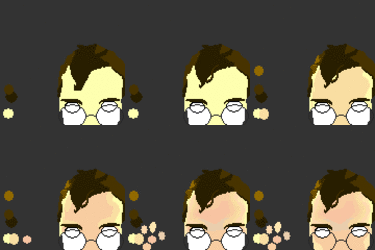
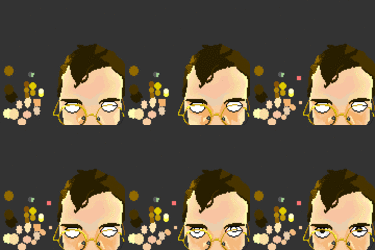
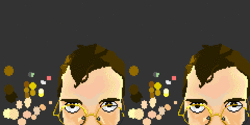
Alright, so I've gotten significantly farther with my avatar... this is going to take a while. And I've got some of it animated for you ^^ which is making it take even longer.


Current stage


By god, I am never using that gif maker again. I used Picasion's free online, "insert only ten files" crap. The last one is actually two frames. behh. If anyone knows freeware gif/animating program that's a legitimate option for this kind of thing please throw me a recommendation in the comments below or a message, anything really. Well, I'm really tired and it's a nice time in the morning to go to bed. So goodnight everyone. I know this was a lackluster post. I'll was looking up a bunch of pixel stuff and I have some links and tell you what I've learned from dicking around with them later. As always, good night and good luck with your projects.

Saturday, January 11, 2014

Pixelstudio Review and Pixel art/animation(a little bit).

Under no circumstances would I want someone to be in a position where they'd need to use Pixelstudio. As far as I could find there are no tutorials on youtube.. probably because everyone would rather use photoshop or whatever else, but still. Don't use it. I don't know if I'm just using it wrong.. but there's no reason it should be that counter intuitive. But as far as I can tell unless you upload an image with color, there isn't a way to change the color scheme past black and white, or any easy way at least. If you cut an image and attempt to move it elsewhere, the dotted line that typically surrounds it will not go away, not easily. And whenever you try to draw while the dotted line is still surrounding your image your drawing will not place. It won't stay. You can't draw. The checkered "see through" background that you typically want to utilize for the edges of your sprites once uncovered, cannot (seemingly) be covered up again. The only way I could figure to fix these problems was by deleting the image I worked on and starting over. This isn't like the program has a million buttons either, it's only a step above mspaint as far as I see, but I couldn't figure these few simply things. Things that should be big and bold obvious fixes for even me. I know this sounds like user error, to a degree I trust it to be, but in school I picked up programs like Illustrator, and Photoshop pretty easily. Heck I had Premier functional in five minutes. Maybe I'm a special kind of dull, but really if programs as intricate as Illustrator/Photoshop and whatever else don't give me this much trouble, I'm just going to write up Pixelstudio as broken. If it's just user error, I'm fine with that, then all that means is the user interface is broken. Or at least it's broken for what we're looking for.

What we're looking for is something that's accessible from the start, that has multiple frame possibilities, and that's popular enough that anyone wanting to know more about the program for whatever reason can find what they're looking for in a five minute Google search. And as much as I'd have preferred if this was it, Pixelstudio is defiantly not that. For me at least. And what happens then is you fall back on what you know, regardless of how counter intuitive it might be.


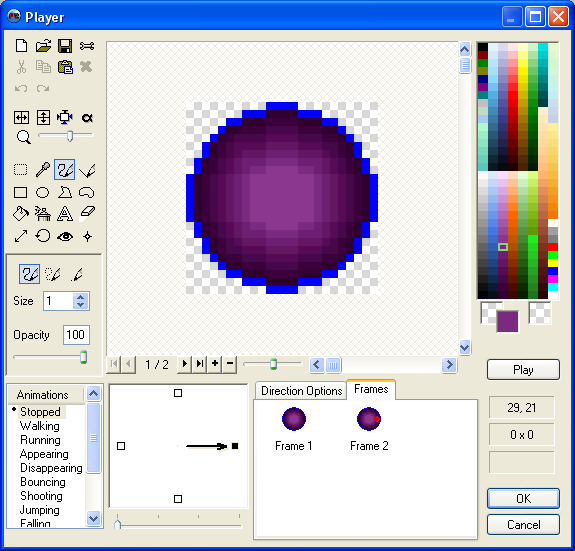
So for now I've fallen back onto my old friend, MMF2's inbuilt sprite editor. Which is more then functional for my needs. It's completely economic for me, it's something I already have and know. Just sounds a bit odd. 

"Oh I'm making this game in AGS, it's really art asset heavy so I spend a bunch of time doing pixel art... No.. actually I use this sprite editor from a completely different game making program... Why aren't I making the game in that other program then? ... Because.. Because I like this editor."

So until I am as familiar with another program I'm just going to use this. 

Looks simple right? That's because it is. Unfortunately this isn't one of those free programs. Really sorry everyone. Honestly though, just use paint and remember to save as a png. That served me just fine for quite a while.. but, for me, with this I can instantly make a new frame with this one instead of saving, then drawing over, then re-saving. So for now I'm just going to work with this one. If anyone's interested in me looking into any of the other free paint programs or do help/tutorial bits on them, I'd love to. But for now I'm going to keep on task, plus no one reads this anyhow. :P

First I had this awesome idea for a gif. But then I realized... I don't even have an avatar for my profile in the forums.. That's sad. Heck, I don't have a personalized avatar anywhere. I just like my pictures of Koalas. God knows there's nothing wrong with that. Bless those little toxic rabid bunny bears.

So that's my first project. 120x120, animated, and see if I can get the level of artz that I see in my head for this project.

(I'll upload the original photo later)
So I messed around with my phone taking selfies, and feeling crap about myself the whole way...mostly because I was aware of myself taking selfies and that I'd have to divulge that fact to the world later here. And ended up with something I didn't quite hate. Then I decided to crop it in the image to leave out my nose. I like the placement of the head, the glasses going off the bottom. And now I just need to do a whole lot more work. This is kind of the first step. Thinking on it now, what I should have do is create a new frame every time I draw a new line/edited it. Then when I'm done I'll have a gif that captures the entire process, the journey is always so much more impressive then the actual finished product. As you can see on the left corner of the subject's brow I attempted crosshatching for the first time with pixels. Not actually bad from a distance, i'll have to experiment more. Bringing that up you can see that the light is actually oriented on both sides from behind the suspect, stronger on one side then the other. Also the eyes look slightly crooked, this is actually just my face being off. One ear is higher than the other so not only do my glasses sit on my face a little crooked, but I tend to hold my head on a slight angle.

My aim at the end of this is to have a realistic(ish) shading, get better at this crosshatch thing(because my project goes for a comic book aesthetics)...

My glasses actually aren't that massive, there about a size or two down in diameter. So.. like maybe three of four pixels smaller in diameter. And they're a little more oval. I have old person glasses, I find them classy. 

On that note I think I captured the distortion from the lens pretty well, it looks like that was what I was trying to do an not just me being bad at art. 

Anywho by the end of this I'd like to have a fully rendered face with some animation. Possibly a bit of background, or not. No, that'd be terrible. I'd like to mention very quickly that this stream of consciousness writing is for the soul purpose of the reader's benefit. My purpose is to show the process. And the process of every work --world changing or seemingly insignificant-- is a great deal of second guessing and consideration, it's also a great deal of, "yeah this is what I got.. it's not great right now, but I'm going to do more." and then doing all of that more until it's finished. It's be prepared to look unsure of youself, and less qualified to be speaking then others, and ignorant, and incompetent. It's being prepared to be sure in yourself enough to let go and show all of that fear and self doubt. To just go all out with what you love regardless of how it looks. Does a blind man dance for others or for himself?
... 
Alright, that's a little out there, what I mean is when you do something that's about creating, and having fun, and self therapy, other people watching you do it shouldn't even be on your mind. I'm not saying ignore people who enjoy your work or don't consider constructive criticism seriously, but don't loose the heart of the thing you love in the idea of others, they don't matter so much for you to have your favorite thing ruined.

.. what the heck was I talking about.

Oh right. I'm going to stick with the gray or similar simple background as a means to draw focus to the character, the animation in the fact of moving will not need help drawing focus. In design simplicity is kings. And the thirds rule is queen. And form over color and text. But be careful around graphic designers with that. We're a very opinionated people. Honestly though, it's form. Design an image like you're colorblind and can't read, focus on form, then add color.. and honestly I don't even know why they have text separately, technically the font is just picking shapes that will go on a page, that falls under the form.. Whatever, I only studied graphic design for a year at school, that's half the program at most, I'm not a real graphic designer. 

Now in my opinion as a stationary image and one that will be on a loop and animated avatar should have a circular animation rather then one that breaks. What I mean by that is say that I used the large empty space to the left of the subject's face and had a hand slowly raising a steaming mug of coffee, have it come to rest briefly, then go down below the screen. My issue with this that visually it's going from a "off" to a "on" position. Mug up->Mug down (repeat)

It's easily distinguishable and feels slightly fractured, it's not a complete smooth continuation of motion, the start and stop nature of it makes it distracting in the corner of the eye.. and to me irritating. It's like watching two bored slow children on a sea-saw, they don't care for it, it's boring, they're just doing it because they can. 

Now say the animation was the mug slowly raising from the bottom, coming to the middle resting for a brief moment, then the animation rest, the mug slowly coming from the bottom again. We see this commonly with reaction gifs. This have definitive ends to the animation and are more synonymous with visual jokes or a punch line. It's a visual sentence.. that gets repeated forever. In the forums this is typically fine behavior, and interesting subject. Banter creates humorous context between two people in a manner that's typically referred to later as "you had to be there" but than an image or emote that's typically mutually understood is used to embody the physical body language, and room dynamic, that might not otherwise exist on a text-form of communication. Text alone is nearly without context in comparison to the other forms of communication we're use to. So the gif can be a punchline for a joke in which you're always there for... unless you don't understand the reference that is. I think if you're introduced to the idea of gifs as part of everyday netchat you have enough context to understand it's (otherwise seemingly arbitrary) placement as a joke. Like you don't get the reference but typically you can see the humor regardless.

Like So


The difference here is that gifs are normally very quick and continue back into themselves instantly. As it is a continual flow of motion it is in a manner creating a visual circle. Bit of an awkward one --like a oval-- but circular non the less. The importance of having a circular animation is creating something that can remain stationary, continue moving, and still look natural. I'll go more into this later but the point is to have something that is dynamic and interesting while fading into the background. This is hugely important with designing idle stances for characters and for animated backgrounds (see I had a point all this time). You animate your background to make an ordinary room more dynamic or control the flow of transitions in room changes or event triggers.  But  you don't want to pull the player out of the experience or draw their attention away from the avatar in game. "Would you look at that, the lighting flashes from that same spot ever two minutes." The background should be just that, a background(unless it's a plot event) animated backgrounds when done well are fantastic, they aid the illusion of depth to your world and aid your player's sense of autonomy within that world. The player walks through a bush and that bush shakes as they pass, giving the player the sense their avatar is has mass and taking the shortcut through the bush instead of walking around was an actual choice and that the choice was meaningful. The best way a designer could emphasize the choice of going through the bush as different than walking around could be in lowering the avatar's speed as they pass through. Or if they pass through while running instead of walking, lower the speed while taking a small amount of damage. This all adds to the player's sense of autonomy, running or walking and where they run or walk is a choice that has repercussions. This sense of allowing the player autonomy while balancing games is what leads to a structure that allows the player to devise strategy and tactics. If a zombie was running at you, you might take the long way through the bushes slowly instead of running around so-that the zombie would follow you, taking damage and coming out of the bushes slowly giving you time on the other end to hack away at the undead mob. In starcraft steam vents shield units from radar, certain obstacles need to be attacked to be broken down, and ledges cannot be jumped. All of these make those elements of the world more real, and together form a tangible environment for the player.


I'm not animating my avatar because it's in a game though, I'm just doing it because it makes it look better, I don't have prior experience making gifs, and .. yeah. Night everyone. ^^

Good luck with your projects. 


Wednesday, April 24, 2013

Ouya... soon to be [M]

OUYA Revisited 

Well, it's been a while and this is soon to hit stores. That's right the 
$99 game console with the free to play market base has been realized. But, really, how realized is it?

The premise of the Ouya's creation is that game consoles don't need to be big and expensive to run games, and that games don't need to cost you an arm and a leg to purchase -could even be free, and that you should be allowed to mod and hack the crap out of whatever item you've paid good money for. Which, to anyone that understands economics, is a very tall order. And the Ouya was designed to set out to create and fill this non-existent space in the market. The idea was that with Android the console could be small and inexpensive, with a free development kit smaller and indie developers would flock to the Ouya and end up creating a flood of top notch titles, and with these titles and the console going for cheap chips the gamer demographic would turn to Ouya as a sort of console Steam on steroids. What went wrong? Well, first the Ouya isn't actually as powerful as the current Android phone you probably have. And second it's competing with the WiiU out, the PS4 right around the corner, and the whatever-Xbox over the hill. 

It's less powerful then all of these and does not have the line up we assume -and more importantly trust with our money- are coming from Microsoft, Sony, and Nintendo. On one hand the Ouya is far cheaper than these other consoles and now that Bioshock Infinite is out nothing seems to be massively grabbing the attention of the consumers right now. This could actually be the perfect time for the Ouya to come out. 

This whole, middle-market indie hot spot plan could really work, especially with the Triple-A Industry in the place it is and this supposed "crash" on it's way. This middle ground market will be the next big thing, if it's from the Ouya though, is still to be seen. This industry -like every industry- thrives on the social buzz of it's products, without the marketing the triple-A titles get the Ouya will inherently have less of a social buzz. Especially without the exclusivity of any high-profile IPs that other consoles have, by comparison the Ouya will inevitably fall into the background. But of course this is all speculative, nothing like this has ever happened before, and the Ouya's unique production and background alone set it apart from the corporate competition  so comparison is pointless, right? Wrong.

Along with it the units shipped to all of the kickstarter benefactors, Ouya is selling in Gamestop right next to the other consoles. It is designed and marketed as an answer and alternate to the higher priced models. In this consoles history, along with recognition as a trail blazer, the Ouya will be compared to the other consoles of the time. Something to note though in this industry is that in the long run a console's worth is not measured souly by the technology under it's hood or even necessarily the money it made compared to this history of all consoles; but by the quality and diversity of its software library. Where the big producers put massive amounts of money and man power into making a handful of titles each year and an even smaller proportion of that will be remembered in the following months the worth consumers place on their three-four hundred dollar device ends up behind the value of roughly ten, fifteen games. Even less if those titles are offered on other preferred more accessible overly useful platforms, say, a computer.

Don't get me wrong, I'm enthralled producers are taking more time and spending serious resources trying to create better products, that is the only way this medium will grow and stretch to its full potential; plus it adds a hard precedent that the smaller studios will have to compete with when creating their own interactive experience. But the time and energy put into creating the moreover lackluster product we see time and time again coming from the triple-A companies does not satisfy the demands of the customer; DLC and patches are only prolonged distractions that are sad attempts to make up for rushed workmanship or to hold the communities attention long enough to ensure they'll be excited for the announcement of the release of the next installment. When none of this works -in most cases- the community looks to satisfy their demands elsewhere. This elsewhere, tends to be Steam, or the digital indie community in general. Plain and simple, customers are more likely to drop ten dollars on three games than fifty on one. And this is where the Ouya has the upper hand. The WiiU has been out for a while now, and how many games have been released for it? The Ouya is not even out yet, and will have a confirmed library of over 500 titles! That's downright unheard of, imagine how many more developers will pick up the Ouya as its community grows. If we're assuming at least the people that backed the Ouya on it's kickstarter page are going to purchase one, you have 65,000 buyer market; which all sounds very profitable, but they've got this whole free to play market base. What's stopping this from just shriveling up from lack of income? We have no idea how that will turn out, nothing similar has ever happened before.

Well actually we have seen this before, and we've seen it succeed. Well not a platform, the Humble Bundle is a pay what you want series of indie game collections that are digitally distributed. Of course the designers give incentive to pay a little extra, if you pay more then the average you get extra titles or features; similar to how the Ouya has free to play with fees for extra features or bonus content. Even while customers are given the choice to pay a single cent for a handful of games the Humble Bundles have, as of February 2013, raised over 33.2 million dollars, with a good percentage of that going to charity. And this did not start off as the pinnacle of the mainstream indie games, these were the awkward and niche genres, the puzzle games and the sidescrollers. This didn't start with never before or exclusive titles, the most mainstream game on the first bundle was World of Goo; a game basically everyone already had, probably pirated. Still the Humble Bundle distribution continues to thrive and brings out more new, exciting, and different titles each sale. The Ouya not only has a chance, but it's very existence makes a pretty strong argument. The Ouya trusts and respects the customers, it trusts the customers to back products and producers they enjoy, it respects the customer's choice to alter a product they've paid for. Most important though, in my mind, the Ouya looks at its customers as friends, instead of as enemies or sheep. And that's something we need more in this industry.


 This was Steve Bullin with a revisit of the Ouya, if you like what you saw or you'd like to see a review of the actual product follow or subscribe to the blog, I will be purchasing an Ouya and reviewing hardware and software later on. Have a good day everyone,(I'm a liar) and don't forget to be awesome. ^^

 Links- Humble Bundle, Ouya