Rather late but finished non-the-less. Here's my bit for DeconstructionCraft on video-games as art, using Cluster theory.
Wednesday, January 22, 2014

Wednesday, January 15, 2014
Progress! Update on Avatar
Few hours of tinkering and 100 or so more saved frames and I have not only recorded the process of going from nothing to my pixel art avatar, but have it animated. ^^ And I found a much better free gif maker.
Here is the image without animation.

With.

I'd still like to detail the plane, do a vapor trail, and of course get rid the numbers and palette on the side. But I wanted to be sure I could get it to animate.
Thankfully this gif sit let's you upload three times the number of frames per gif. (when you see a name pop up on the screen that's just me giving a shout out to the individuals that gave me a hand in the forums with this.


Faster makes the animation look smother.


This is because of the number of frames Finding just the right number of frames for the speed you want to trick the viewer's mind into precieving the animation as continued motion is a science like cooking is a science, you tend to just go by your gut, sorta wing it.
End of the day, While I'm really glad I got it to animate and that I've found a decent gif site, I don't think I'm going to use the animated final.
I'm still going to finish detailing it, and I've had a great time with the project, I just get the feeling the still allows the viewer a better look at the piece. The focus isn't pulled away with the movement. And once I've finished the plane maybe that'll change, who knows.

But until then, keep experimenting, goodnight, and good luck everyone.
Monday, January 13, 2014
What makes a thing that has pixels "Pixel Art"?
I'm going to site a particular moment from the AGS forums for you. Because it was an important moment for me where it fully clicked, when it comes to sprites, images, resolution, and some of the other terminology that makes sense of images we use in digital art.

My previous draft (as recorded in this post) for creating my own pixel art avatar gif was thus
Unfortunately
"I think the palette is okay. But if I were to be really literal here, this is NOT pixel art. You are using merging gradients and soft brushes, both of which are not used in traditional pixel art. See also here: http://www.pixeljoint.com/forum/forum_posts.asp?TID=11299"
By god this is better criticism then I could have hoped for. I say that in all sincerity, I'm a newbie --sure I know the kind of results I want to end up at-- but I have no idea of how to get there. I had seen some examples of this dithering thing that's used for shading, but once that got a little complex went right back to what I know. Using a crap ton of gradients. This soft transition from one shade to the next almost makes the use of pixels invisible. Which entirely misses the point of pixel art, high amount of control and focus on the pixel as the tool, and as a visible tool used in the art. I seriously encourage anyone whose looking into making games and especially people who want to do art for their games to give this a serious read.
So along with a great amount of insight from that article on how do do this art and such, note the valuable examples of styles of dithering, the commentary on anti-aliasing, jaggies, and --one of my personal favorite technique errors-- pillow shading. Also understanding the difference and --more importantly-- proper use of hue, saturation, and luminosity. In all honesty I had kind of forgotten the difference between hue and saturation.. mostly just because I forgot what hue was, saturation is pretty self evident. I had basically just dragged the mouse around on the color finder until it was slightly darker or lighter. I feel stupid about getting them confused. I mean, I've learnt this, this. No point in focusing on the negative. So what to do. Well I'm going to change the color scheme ^^. The issue I was having from the get go was trying to get the exact right amount of red or yellow in the skin tones. And, while with more time it might be possible for me to get this to the realistic(ish) style I was aiming for, diving into full color scale is me diverging from my original goal. I wanted to practice dithering and shading, I wanted to achieve a level of believably with a strong pixel art approach. I wasn't going for photo-realism, I wanted a believable rendering, but believable and photo-realistic are two entirely separate beasts. So to focus on learning dithering I'm going to cut it back to a bichromatic palette.
That's the plan, I'm going to get to work. Good night everyone and good luck with your projects.
Sunday, January 12, 2014
How to Gif.. Please really how?
Alright, so I've gotten significantly farther with my avatar... this is going to take a while. And I've got some of it animated for you ^^ which is making it take even longer.


_53.png)


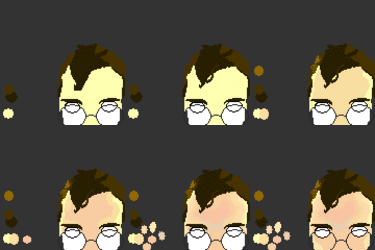
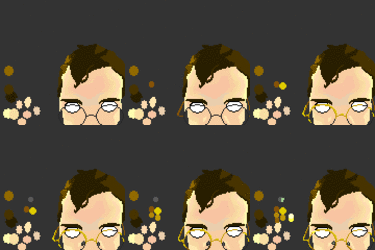
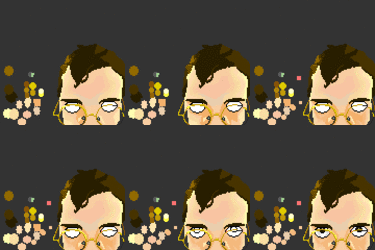
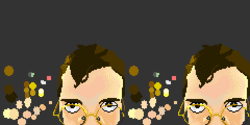
Current stage
By god, I am never using that gif maker again. I used Picasion's free online, "insert only ten files" crap. The last one is actually two frames. behh. If anyone knows freeware gif/animating program that's a legitimate option for this kind of thing please throw me a recommendation in the comments below or a message, anything really. Well, I'm really tired and it's a nice time in the morning to go to bed. So goodnight everyone. I know this was a lackluster post. I'll was looking up a bunch of pixel stuff and I have some links and tell you what I've learned from dicking around with them later. As always, good night and good luck with your projects.
Saturday, January 11, 2014
Pixelstudio Review and Pixel art/animation(a little bit).
Under no circumstances would I want someone to be in a position where they'd need to use Pixelstudio. As far as I could find there are no tutorials on youtube.. probably because everyone would rather use photoshop or whatever else, but still. Don't use it. I don't know if I'm just using it wrong.. but there's no reason it should be that counter intuitive. But as far as I can tell unless you upload an image with color, there isn't a way to change the color scheme past black and white, or any easy way at least. If you cut an image and attempt to move it elsewhere, the dotted line that typically surrounds it will not go away, not easily. And whenever you try to draw while the dotted line is still surrounding your image your drawing will not place. It won't stay. You can't draw. The checkered "see through" background that you typically want to utilize for the edges of your sprites once uncovered, cannot (seemingly) be covered up again. The only way I could figure to fix these problems was by deleting the image I worked on and starting over. This isn't like the program has a million buttons either, it's only a step above mspaint as far as I see, but I couldn't figure these few simply things. Things that should be big and bold obvious fixes for even me. I know this sounds like user error, to a degree I trust it to be, but in school I picked up programs like Illustrator, and Photoshop pretty easily. Heck I had Premier functional in five minutes. Maybe I'm a special kind of dull, but really if programs as intricate as Illustrator/Photoshop and whatever else don't give me this much trouble, I'm just going to write up Pixelstudio as broken. If it's just user error, I'm fine with that, then all that means is the user interface is broken. Or at least it's broken for what we're looking for.
What we're looking for is something that's accessible from the start, that has multiple frame possibilities, and that's popular enough that anyone wanting to know more about the program for whatever reason can find what they're looking for in a five minute Google search. And as much as I'd have preferred if this was it, Pixelstudio is defiantly not that. For me at least. And what happens then is you fall back on what you know, regardless of how counter intuitive it might be.


So that's my first project. 120x120, animated, and see if I can get the level of artz that I see in my head for this project.

So I messed around with my phone taking selfies, and feeling crap about myself the whole way...mostly because I was aware of myself taking selfies and that I'd have to divulge that fact to the world later here. And ended up with something I didn't quite hate. Then I decided to crop it in the image to leave out my nose. I like the placement of the head, the glasses going off the bottom. And now I just need to do a whole lot more work. This is kind of the first step. Thinking on it now, what I should have do is create a new frame every time I draw a new line/edited it. Then when I'm done I'll have a gif that captures the entire process, the journey is always so much more impressive then the actual finished product. As you can see on the left corner of the subject's brow I attempted crosshatching for the first time with pixels. Not actually bad from a distance, i'll have to experiment more. Bringing that up you can see that the light is actually oriented on both sides from behind the suspect, stronger on one side then the other. Also the eyes look slightly crooked, this is actually just my face being off. One ear is higher than the other so not only do my glasses sit on my face a little crooked, but I tend to hold my head on a slight angle.
What we're looking for is something that's accessible from the start, that has multiple frame possibilities, and that's popular enough that anyone wanting to know more about the program for whatever reason can find what they're looking for in a five minute Google search. And as much as I'd have preferred if this was it, Pixelstudio is defiantly not that. For me at least. And what happens then is you fall back on what you know, regardless of how counter intuitive it might be.

So for now I've fallen back onto my old friend, MMF2's inbuilt sprite editor. Which is more then functional for my needs. It's completely economic for me, it's something I already have and know. Just sounds a bit odd.
"Oh I'm making this game in AGS, it's really art asset heavy so I spend a bunch of time doing pixel art... No.. actually I use this sprite editor from a completely different game making program... Why aren't I making the game in that other program then? ... Because.. Because I like this editor."
So until I am as familiar with another program I'm just going to use this.
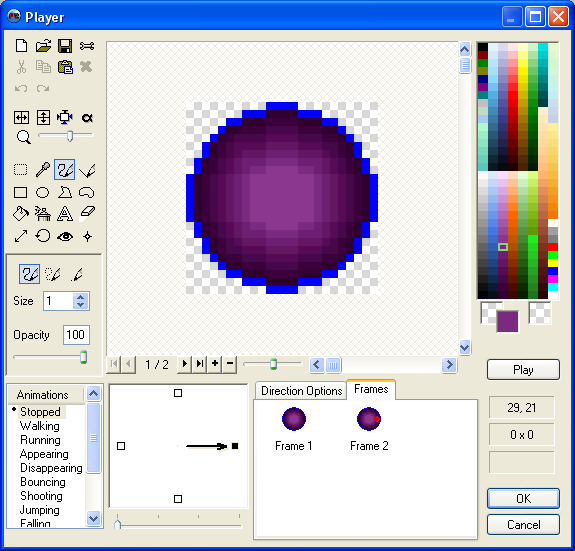
Looks simple right? That's because it is. Unfortunately this isn't one of those free programs. Really sorry everyone. Honestly though, just use paint and remember to save as a png. That served me just fine for quite a while.. but, for me, with this I can instantly make a new frame with this one instead of saving, then drawing over, then re-saving. So for now I'm just going to work with this one. If anyone's interested in me looking into any of the other free paint programs or do help/tutorial bits on them, I'd love to. But for now I'm going to keep on task, plus no one reads this anyhow. :P
First I had this awesome idea for a gif. But then I realized... I don't even have an avatar for my profile in the forums.. That's sad. Heck, I don't have a personalized avatar anywhere. I just like my pictures of Koalas. God knows there's nothing wrong with that. Bless those little toxic rabid bunny bears.
So that's my first project. 120x120, animated, and see if I can get the level of artz that I see in my head for this project.
 |
| (I'll upload the original photo later) |
My aim at the end of this is to have a realistic(ish) shading, get better at this crosshatch thing(because my project goes for a comic book aesthetics)...
My glasses actually aren't that massive, there about a size or two down in diameter. So.. like maybe three of four pixels smaller in diameter. And they're a little more oval. I have old person glasses, I find them classy.
On that note I think I captured the distortion from the lens pretty well, it looks like that was what I was trying to do an not just me being bad at art.
Anywho by the end of this I'd like to have a fully rendered face with some animation. Possibly a bit of background, or not. No, that'd be terrible. I'd like to mention very quickly that this stream of consciousness writing is for the soul purpose of the reader's benefit. My purpose is to show the process. And the process of every work --world changing or seemingly insignificant-- is a great deal of second guessing and consideration, it's also a great deal of, "yeah this is what I got.. it's not great right now, but I'm going to do more." and then doing all of that more until it's finished. It's be prepared to look unsure of youself, and less qualified to be speaking then others, and ignorant, and incompetent. It's being prepared to be sure in yourself enough to let go and show all of that fear and self doubt. To just go all out with what you love regardless of how it looks. Does a blind man dance for others or for himself?
...
Alright, that's a little out there, what I mean is when you do something that's about creating, and having fun, and self therapy, other people watching you do it shouldn't even be on your mind. I'm not saying ignore people who enjoy your work or don't consider constructive criticism seriously, but don't loose the heart of the thing you love in the idea of others, they don't matter so much for you to have your favorite thing ruined.
.. what the heck was I talking about.
Oh right. I'm going to stick with the gray or similar simple background as a means to draw focus to the character, the animation in the fact of moving will not need help drawing focus. In design simplicity is kings. And the thirds rule is queen. And form over color and text. But be careful around graphic designers with that. We're a very opinionated people. Honestly though, it's form. Design an image like you're colorblind and can't read, focus on form, then add color.. and honestly I don't even know why they have text separately, technically the font is just picking shapes that will go on a page, that falls under the form.. Whatever, I only studied graphic design for a year at school, that's half the program at most, I'm not a real graphic designer.
Now in my opinion as a stationary image and one that will be on a loop and animated avatar should have a circular animation rather then one that breaks. What I mean by that is say that I used the large empty space to the left of the subject's face and had a hand slowly raising a steaming mug of coffee, have it come to rest briefly, then go down below the screen. My issue with this that visually it's going from a "off" to a "on" position. Mug up->Mug down (repeat)
It's easily distinguishable and feels slightly fractured, it's not a complete smooth continuation of motion, the start and stop nature of it makes it distracting in the corner of the eye.. and to me irritating. It's like watching two bored slow children on a sea-saw, they don't care for it, it's boring, they're just doing it because they can.
Now say the animation was the mug slowly raising from the bottom, coming to the middle resting for a brief moment, then the animation rest, the mug slowly coming from the bottom again. We see this commonly with reaction gifs. This have definitive ends to the animation and are more synonymous with visual jokes or a punch line. It's a visual sentence.. that gets repeated forever. In the forums this is typically fine behavior, and interesting subject. Banter creates humorous context between two people in a manner that's typically referred to later as "you had to be there" but than an image or emote that's typically mutually understood is used to embody the physical body language, and room dynamic, that might not otherwise exist on a text-form of communication. Text alone is nearly without context in comparison to the other forms of communication we're use to. So the gif can be a punchline for a joke in which you're always there for... unless you don't understand the reference that is. I think if you're introduced to the idea of gifs as part of everyday netchat you have enough context to understand it's (otherwise seemingly arbitrary) placement as a joke. Like you don't get the reference but typically you can see the humor regardless.

Like So
The difference here is that gifs are normally very quick and continue back into themselves instantly. As it is a continual flow of motion it is in a manner creating a visual circle. Bit of an awkward one --like a oval-- but circular non the less. The importance of having a circular animation is creating something that can remain stationary, continue moving, and still look natural. I'll go more into this later but the point is to have something that is dynamic and interesting while fading into the background. This is hugely important with designing idle stances for characters and for animated backgrounds (see I had a point all this time). You animate your background to make an ordinary room more dynamic or control the flow of transitions in room changes or event triggers. But you don't want to pull the player out of the experience or draw their attention away from the avatar in game. "Would you look at that, the lighting flashes from that same spot ever two minutes." The background should be just that, a background(unless it's a plot event) animated backgrounds when done well are fantastic, they aid the illusion of depth to your world and aid your player's sense of autonomy within that world. The player walks through a bush and that bush shakes as they pass, giving the player the sense their avatar is has mass and taking the shortcut through the bush instead of walking around was an actual choice and that the choice was meaningful. The best way a designer could emphasize the choice of going through the bush as different than walking around could be in lowering the avatar's speed as they pass through. Or if they pass through while running instead of walking, lower the speed while taking a small amount of damage. This all adds to the player's sense of autonomy, running or walking and where they run or walk is a choice that has repercussions. This sense of allowing the player autonomy while balancing games is what leads to a structure that allows the player to devise strategy and tactics. If a zombie was running at you, you might take the long way through the bushes slowly instead of running around so-that the zombie would follow you, taking damage and coming out of the bushes slowly giving you time on the other end to hack away at the undead mob. In starcraft steam vents shield units from radar, certain obstacles need to be attacked to be broken down, and ledges cannot be jumped. All of these make those elements of the world more real, and together form a tangible environment for the player.
I'm not animating my avatar because it's in a game though, I'm just doing it because it makes it look better, I don't have prior experience making gifs, and .. yeah. Night everyone. ^^
Good luck with your projects.
So I'm making these things again.
So after not really being able to wrap my mind around code. I opted to step it back and start simple. Something I typically try but end up trying to sneak in more features then a program is flexible enough for. And by that I typically mean doing so meant a more code heavy revise than I could handle.. But I think I've found the right thing. And I think this might be the hardest thing for starting up designers (or those of us that have never finished a project on our own), you need to find tools that are simple enough for you to wrap your mind around using them to create your idea, and the tool has to look simple enough and be the least amount of threatening on approach that you don't feel intimidated and overwhelmed when learning.
But my point is, it's nice to know that the set of stairs that lead to your dream projects aren't always as massive as you think. Dream accomplishments aren't nearly as impossible as we think, the tasks are actually very human and legitimately possible.

And, my goal on this blog now.. along with using it to help keep me honest and frequent with my internship writing. Is to show off how possible these dream projects are. I've always been a massive fan of Wolfire Games' marketing strategy of showing start to finish because I know how much that meant to me when I was first thinking of game design. That sudden realization that follows being introduced to your deepest dream activity as a realistic profession, "Crap.. this could be what I do. Even if I need to do a second job, I could be doing this. I could be making those kinda things." That realization that game design and creation wasn't... it wasn't something so out of reach, not a "I could never do that.." situation. And when I first saw those games being made, when I followed the squares on screen betas turn to polished alpha releases, all of that just got me so excited. I spent.. well I haven't stopped thinking about games. Not just as a retreat, or pastime like they were before, but as my worlds. Instead of retreating into a book or movie or game like it was a favored place to be comfortable and be myself in, I started retreating into these as if they were close friends that whispered hints and tricks about how to excite the audience, make them laugh, or make them care. My notebooks at school actually started being used.

And I was draw to ags initially the way I am typically drawn to something.. it was free. Spending the time to download and drudge through the tutorials is some of the best time I've spent. And I say that as a poor, currently under-slept, not quite starving college student. It's break right now for Christ sakes and I can't get myself to sleep in. I'm super excited to have one of my old designs not only off the back-burner (as I now have tools to slowly coax pages of scribbles into sweet digital life), but not just off the back-burner, but to see the tools at my disposal and realize how very doable this vision is. Often with a design orientation, you get an idea for something --and any good designer will tell you, it's not the thing that matters it's the manner in which it works, that makes a truly good design-- and when you don't have any training or understand the vocabulary of how your pen works(coding; in a manner of speaking) then you have the assumption your grand idea isn't possible and is too complex mechanically. And that's what I had thought for the longest time with many of my designs, so what did I do. I focused on the gameplay, the input output relations with the player and the essentials of what really made something. Because if I could figure that, and break a game down to it's smallest components, and then possibly get myself to the point of building those components, then I could design a project solely around that singular component, and then with time build on new features learn and work up to an engine that I could use to build the stories I wanted to.
Once to build a metroid-ish/brawl platformer I started the designs for five separate titles that slowly scaled back the functions of the game until the one I started working on was literally two frogs that could either step forward or backward and were fencing with their tongues. Like a dive kick game, but it's step forward or step backward kick. Attacking while stepping forward made a simple straightforward thrust. A backward step with a attack would make a sideways slash that could parry a hit. That was it. You would go forward in an attack or move back to defend.
And really, I'll probably end up using that same strategy to make my final products, lord knows it'd help fill out the empty file designated for finished products.
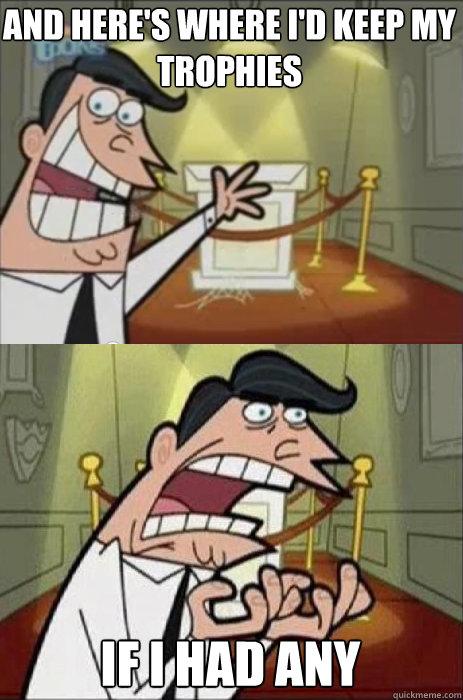 |
| Any finished product is a trophy in itself |
But my point is, it's nice to know that the set of stairs that lead to your dream projects aren't always as massive as you think. Dream accomplishments aren't nearly as impossible as we think, the tasks are actually very human and legitimately possible.
And, my goal on this blog now.. along with using it to help keep me honest and frequent with my internship writing. Is to show off how possible these dream projects are. I've always been a massive fan of Wolfire Games' marketing strategy of showing start to finish because I know how much that meant to me when I was first thinking of game design. That sudden realization that follows being introduced to your deepest dream activity as a realistic profession, "Crap.. this could be what I do. Even if I need to do a second job, I could be doing this. I could be making those kinda things." That realization that game design and creation wasn't... it wasn't something so out of reach, not a "I could never do that.." situation. And when I first saw those games being made, when I followed the squares on screen betas turn to polished alpha releases, all of that just got me so excited. I spent.. well I haven't stopped thinking about games. Not just as a retreat, or pastime like they were before, but as my worlds. Instead of retreating into a book or movie or game like it was a favored place to be comfortable and be myself in, I started retreating into these as if they were close friends that whispered hints and tricks about how to excite the audience, make them laugh, or make them care. My notebooks at school actually started being used.
BACK ON TRACK
So, soon as I pull together the braincells to figure out fraps.. (probably lost half the audience, I swear I'm not completely incompetent), I'll record myself working on this project. Possibly do a tutorial session about everything that goes wrong and how to trouble-spot where you're going wrong.. because I think I've run into almost all of the most basic ones and in trying to find what's wrong realized there isn't a single person on the internet who was simple enough to make the same ignorant mistakes I've made. Thus far I've figured all the problems I've run into by myself (I'm very proud). There will undoubtedly be more in the future. But for now I'm going to upload and dictate my design process, both selections from my notebook on how I'm mapping and keeping track of the perspectives. And mentions of what I learn, as I learn the AGS editor and coding tips and hints.
-My first error, which was one of the most frustrating, was the room I had created was unable to load the background image I had drawn for it. Which was frustrating because I'd go back and forth between the general settings and the image I had made because they were the same size, pixel for pixel; and the computer told me they weren't. The issue had been, of course, the room actually wasn't the same size as the general setting, this was because after I had made the first room I changed the general setting size. This was because I made the room, checked the size, looked at my image editor and realized I wanted it bigger. The rooms are built off the general settings but once built isn't linked to those general settings anymore. The resolution does not bend back and forth to my will in these separate rooms. So basically all I did was delete the room, remake it, and the image worked. That took me two days to figure out. I want you to see me in all my pathetic glory so when I have something to show and you're first reaction is "meh, alright.. that's kinda neat." You'll see how far I've come.
-And here's my coup de gras, or at least I hope it's the most facepalm I get learning this... Facepalm.. Facepalm Games.. that's what I should call my youtube development videos! You see you have to find a way to make it fun, you even have to make losing fun, with my history of game making, this is going to be a whole lot of fun.
My coup de gras was I couldn't get the inbuilt editor to draw walkable areas. I'd select every tool in the little bar, draw rectangles, draw line tool, draw pen tool, and all those other things.. I don't know what do.. But anytime I'd try to draw on the page it'd tell me that I couldn't do that, that I had the eraser selected. And I'd get very upset because I didn't. And it was saying crap about a properties plane, and I couldn't find what they were talking about. It made me very upset, but I had seen the light at the end of the tunnel.. this was possible and this design has been brewing in my head for almost two years, the functions I thought I couldn't do and the art-style had been brewing for four years, and that functionality was literally a number of months of work away. It was possible, I was just being ignorant, and I'd make it work. Enter roughly four days of doing almost nothing but fart around on my computer trying different things on the editor and having five tabs open looking through basic tutorials later I realized I had the properties of the room set on Walkable Area 0... as in no walkable area at all. Meaning I wasn't drawing.. which would automatically set the pen to a function that wouldn't work.

No matter what you start learning, you will always start off making mistakes you will laugh at in the future. So enjoy it, realizing painful ignorance is the universe's way of making learning fun.
My next hurdle.. along with everything coding. Is to find a good paint program to get the kind of pixel art I'm looking for. So far I'm using Sketchbook Express 2011, and with some farting about I might be able to get the precision stuff that I want but right now the settings are giving a difficult to control --as it's designed for tablet and pen(a set i don't really have)-- and faded soft brush effect in the lines. And.. well I'm looking for more pixel accurate hard color effect. Plus this isn't a program everyone can download. So I've downloaded and will come up with a review for PixelStudio next post along with more on the Island.
Goodnight everyone, good luck with your projects.
Tuesday, December 17, 2013
why or why not?
https://www.youtube.com/watch?v=ejc5zic4q2A#t=3313
The hardest thing about doing anything, is that you are doing it for everyone along with yourself with the chance that no one will hear, and the place you put yourself in is a place everyone can attack. That in itself may be selfish, that you want someone to hear and appreciate your voice/art/idea the way you have, but on some level it must stem from a desire to share. The same way when you find a really good book, or film, or music you know someone else will like and you hold onto that piece of work and will even defend it because you see it for its merits. And you are thankful for those merits because for whatever time you had an escape, you had something that you felt was great.

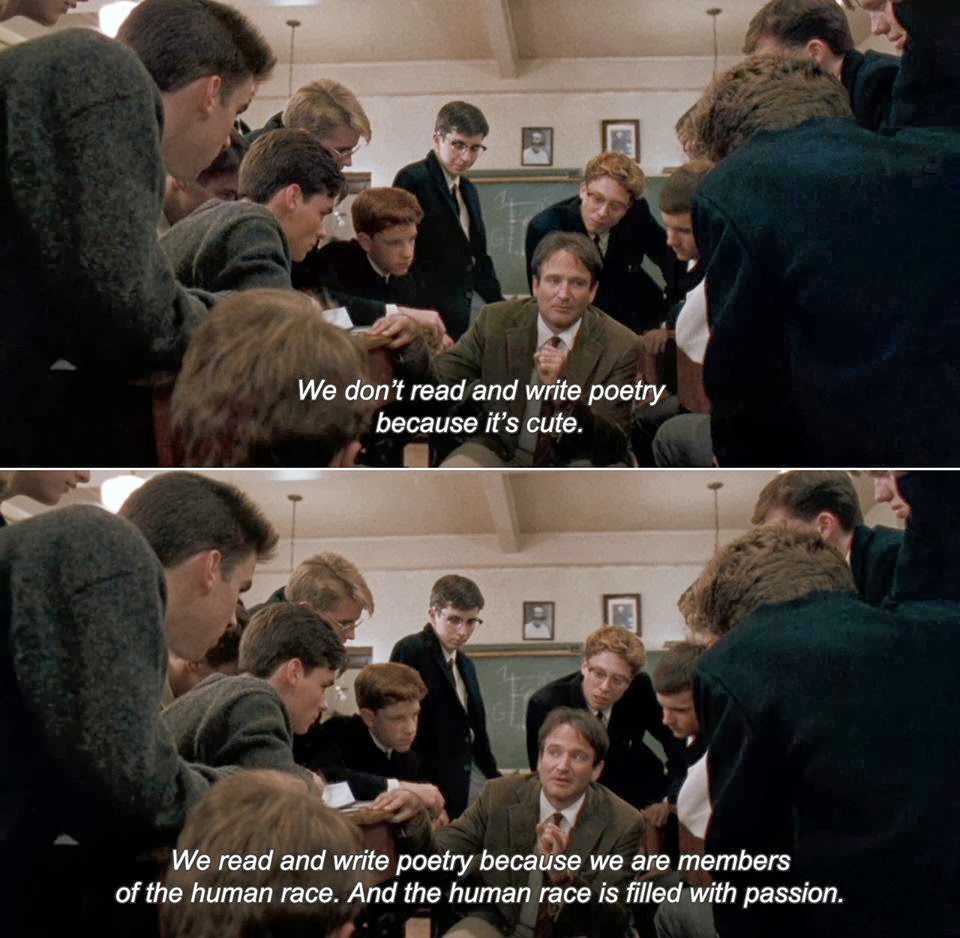
The hardest thing about doing anything, is that you are doing it for everyone along with yourself with the chance that no one will hear, and the place you put yourself in is a place everyone can attack. That in itself may be selfish, that you want someone to hear and appreciate your voice/art/idea the way you have, but on some level it must stem from a desire to share. The same way when you find a really good book, or film, or music you know someone else will like and you hold onto that piece of work and will even defend it because you see it for its merits. And you are thankful for those merits because for whatever time you had an escape, you had something that you felt was great.

On the part of the creator I'd argue it's even more difficult, when you hold that part of you that identifies with the art you are not just risking something that gave you escapism and joy for a time, you are holding up something that is deeply a part of your release. At least if you care about your work.. than what you hold up is almost everything. And having that knowledge as you sit down and go over your work is one of the most terrifying things. I think artists have a tendency to be both the most blind and critical of their own work, in one sense I see them becoming blind to the flaws of their work so they can just release to their passion without hesitation because that is the only way to get it finished, and in another sense I see them agonizing over every out of place detail or miss-step along the way because that is the only way to get better. Every chief considers himself food critic, every artist a authority on their craft, every writer, and so on and so forth. Everyone is a critic, everyone.
And yet the anxiety ridden artist, over-stressed writer, and depressed performer still sit down to their craft. For a time they shut down that part of their brain that asks "why bother", they say "because" and in their release find catharsis in their work. That catharsis shows in the artist and the understanding audience will see it as something true, because at the end of the day it's the way it's done inside the artist that makes it distinguished. And with time that internalized care for the doing, that passion and obsession over the art becomes the guiding light of self criticism and refinement, and in time the informed critics see that as improvement, as a refined craft. But the audience will not always be understanding and the critics will not ultimately judge the material by the craft or its stand alone merits. And worse then that the artist will not always be within their work nor will they have reflected upon their work enough to take criticism as constructive.
When I work there are a few things that are always going through my mind.
All of my life I've been proven a novice... All of it. I'm only halfway decent at anything I consider myself "skilled" at. Anytime someone gives me a task I plan out my procedure based on what experience and education I've had and then look at the task realizing how blatantly lost I am. Only occasionally do I have moments when I'm less lost than the people around me, but it's clear I'm only a step if that ahead. I'm a assistant chef for a living and I can't do anything for myself without burning at least one thing every other week. We're all just stumbling through life, it's okay to acknowledge that. Every professional makes the occasional novice mistake. It's perfectly within the novice's right to be kinda terrible at what they do. I hold this saying to heart so I feel a little less pathetic every day, I hope it helps you too.
We are the incomprehensibly small and insignificant specs in the briefest moment of time and space and the entirety of our existence will make no difference.
This will very likely be fact to some effect. Nihilists look at the mother and say "Even if you love your child ever day and work hard to provide for them, there are days when they will hate you, they might even abandon you. When you are old and weak they will be spending too much time with their own families to visit you when you are lonely. You feel fulfilled and individualized by a role that is a simply biological function and ultimately meaningless." they say to the artist "Your work will be misconstrued and ultimately forgotten by the few that recognize it. You're position only fills the world with trivial appeal while you could be doing real good in the world. You're fulfillment is prideful and self-centered, who are you to think you deserve what you've earned for your work?" they say these things to the soldier and to the teacher. But I don't believe nihilists are seeing it through all the way. They view the act as insubstantial because the end result, but I don't think they really think about the fact that it's still happening despite the result, or what that might mean. The mother knows that her child might leave her, but when she goes on loving and devoting herself to her child regardless, when she is doing the act for the sake of the act doesn't that make it more pure? If a mother loves her child because it is her child and she feels at her core the thing to do is love it, that she'll fight herself in moments of anger and frustration because despite herself she loves her child, doesn't that make parenting so much more pure? When the artist looks at their art in the grand scheme and sees how it means nothing but continues despite everything doesn't that make the art that much more genuine and possibly important a thing?
I think this sense we have towards one another, this awe in the face of true artistic integrity is a reflection of our value of ambition in its most basic form. Because that is a place we can empathize with. When someone wants to write a novel to help pay for their third house it's not something we can easily relate to, it and its owner are just not real to us. When we write short stories or novels we do it for the challenge of doing it. We do it for the love of writing. And when we see someone that has maintained that kind ambition we can relate to, it can be a kind of religious experience for us. We see our favorite musicians or actors, or go to book signings and become star struck. Because we see that ambition maintained in the face of everything as something great and human. Maybe we empathize with that kind of pure ambition, without the money or fame, because deep down we don't consider ourselves good enough to get to that point of fame and wealth... maybe it's just because deep down that's not something we really want. Typically people say they'd rather do what they love and have to do whatever extra work to make enough to just get by than be rich and not be able to do what they love...
I think this says alot about us.
I don't know what anyone will think about this or what they'll get out of it, but I wrote it. A part of me wishes I could say I don't, but I do care what people think and get out of this. An overwhelming part of me cares because this isn't me shouting out into a empty moment in time and space this is me sharing a thought with you, the reader. I hope it finds you well. I hope you think a little better about whatever it is you do but mostly I hope you feel better about yourself. Not more inflated, this has nothing to do with ego. This is not about perception, this is about self worth. Ego is a sense that is compared against other, that is to look at a mirror and think of yourself in the terms you might imagine or hope to imagine other's consider you. Self worth, I believe, is a sense of looking in the mirror and acknowledging a human like every other human. A thing that has unimaginable greatness within it, a thing that is inherently beautiful, and flawed, hilarious, profound, and caring, and so very valuable.
Goodnight.
Subscribe to:
Posts (Atom)